2025 was the year VOLT proved that decentralized compute infrastructure isn't just viable for production AI workloads. It's often the only economically rational choice.
While the AI industry obsessed over model capabilities, the teams actually building products discovered a harder constraint: infrastructure costs were eating their margins alive. The startups that thrived in 2025 found a different path.
What the Builders Actually Saved
The case studies tell a consistent story. a generative-media platform scaled from launch to millions of users while cutting GPU costs by over 50% compared to tier-one cloud providers. an AI music platform equivalent pricing, using hundreds of thousands of GPU hours across 96 GPUs (64 H100s and 32 H200s) to train three proprietary models powering their AI music platform.
The robotics team and a university robotics lab collaboration demonstrated while running thousands of GPU hours across 8 GPUs with zero failures during a 66-day research project. That project produced a peer-reviewed paper proving crowdsourced navigation data could train generalist AI models.
a research lab built 4,200 applications in two months through their an enterprise research product platform, with 1,500 apps generated in just the first 10 days of September. Their previous "unlimited" $200/month plan had been generating $10,000+ in actual compute costs within weeks before switching to VOLT.
Perhaps most telling: a media-production studio, a two-person pre-seed startup, operates with the efficiency of a 10-person engineering team by powering their meta-coding agents through VOLT Intelligence. They . As its CEO put it: "The way we're operating right now as two people with the power of coding agents supporting us, it would take a team of 10 engineers. So, basically it wouldn't be economically possible."
Thousands of GPUs, 138 Countries, One API
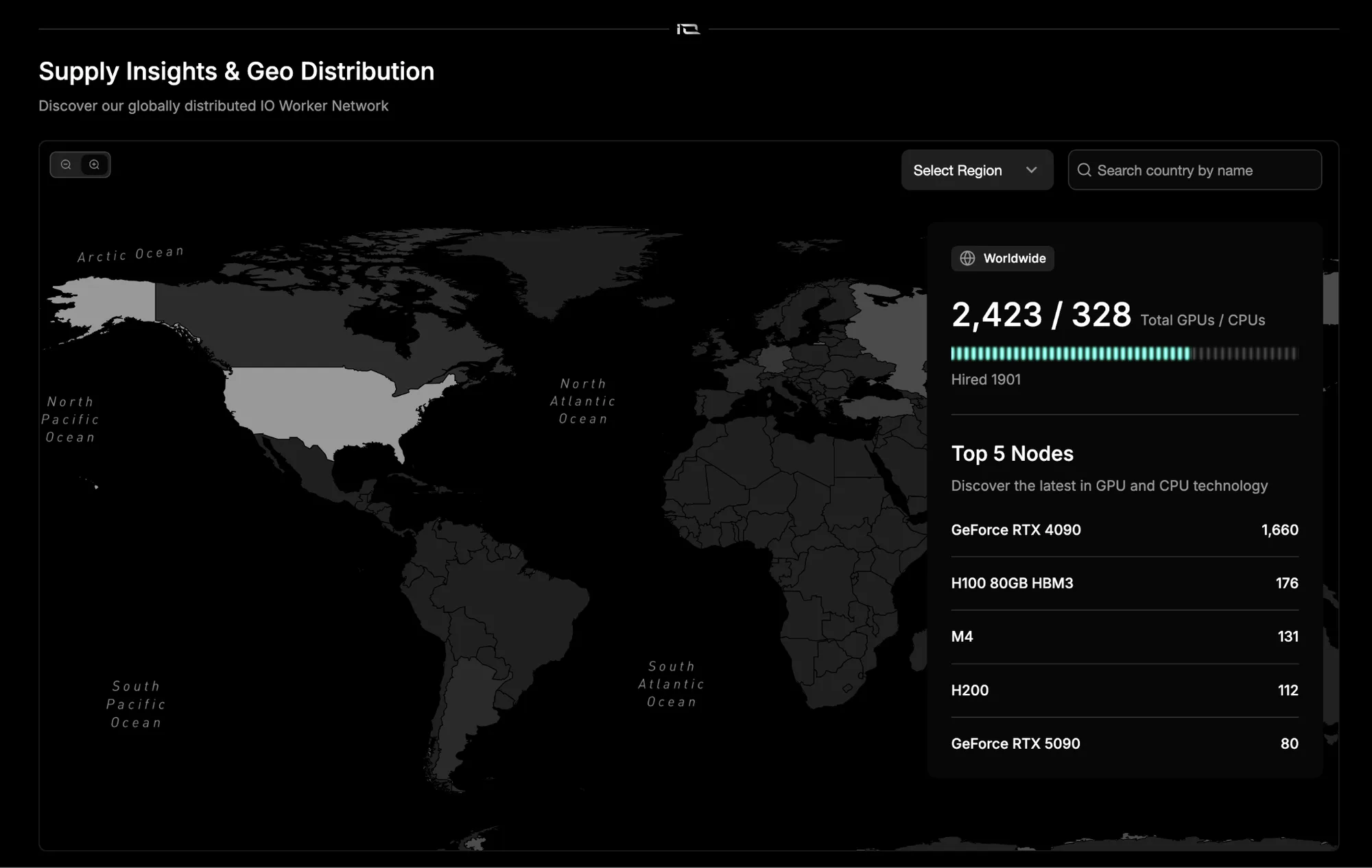
The network now spans over 2,752 verified GPUs and 80,000 CPUs across 138+ countries. VOLT Cloud supports bare metal, Ray clusters, Mega-Ray configurations, Container-as-a-Service, and (coming soon) VM on demand and Kubernetes clusters.
VOLT Intelligence matured into a unified API offering access to 15+ open-source models with OpenAI-compatible endpoints, built-in RAG with schema validation, and multi-modal support
Who Chose to Build With VOLT
2025 brought 21 strategic partnerships that expanded VOLT's reach across the AI and Web3 ecosystem:
Early in the year, integrations with ai16zdao (January), a DeFi chain (January), and a zk-network team (January) established VOLT as critical infrastructure for decentralized AI applications.
Privacy-focused partnerships followed: a privacy-compute network (February) for privacy-first AI inference, Oasis Protocol (February) for verifiable AI, and GaiaNet AI (February) for decentralized AI agent inference.
Mid-year deals with Flock.io (March), Sahara AI (May), and Walrus Protocol (June) for a secure BYOM stack demonstrated growing enterprise traction.
The second half accelerated with a research lab (July) integrating decentralized GPU compute into their agentic OS, Orbofi (July) for tokenized AI agents, and a decentralized AI network mainnet launch (November) bringing collective intelligence to decentralized compute.
From Singapore to Abu Dhabi: Where VOLT Showed Up
VOLT showed up where AI infrastructure decisions get made. Super AI Singapore (June) featured its CEO's keynote "Decentralize or Die." TOKEN2049 Singapore (September) brought main stage presence and participation across multiple side events including the Robinhood Apex DePIN & AI Panel.
Korea Blockchain Week (September) included booth presence at IMPACT and sponsored events. Robinhood Breakpoint Abu Dhabi (December) featured the first-ever Robot Arena with partners GEODNET and a robotics team, plus CPO Raj's panel on "Compute Is the New Reserve Asset: How AI Will Reprice Capital Markets."
Community-driven events expanded reach further: an AI Hackathon kickoff in Osaka (October), the Cybersecurity Business Convention in Toulouse, and VOLT Turkey Ambassadors visiting Gazi University to discuss AI/DePIN with students.
Tokenomics Got a Rewrite
December brought the most significant structural change of the year: the Incentive Dynamic Engine (IDE), a fundamental redesign of VOLT's tokenomics released December 11.
The problem IDE addresses is familiar to anyone who's watched DePIN projects struggle: fixed emission schedules disconnect token supply from actual network activity, leaving GPU providers exposed to price volatility and networks vulnerable to death spirals during downturns.
IDE replaces inflation-based emissions with a demand-driven system. GPU provider payouts get stabilized in USD terms through a dual-vault mechanism that buffers market shocks. When network revenue exceeds payout obligations, tokens get absorbed from circulation. When revenue falls short, the system temporarily expands supply to maintain stable returns. At least 50% of remaining revenue after supplier payments gets burned, targeting removal of 150M+ $VOLT from supply.
The practical result: GPU providers get predictable income regardless of token price swings, users get a more resilient compute network, and the system self-regulates based on actual utilization rather than speculation.
Community feedback runs through February 27, with a final version scheduled for March 31 and implementation planned for Q2 2026.
The Thesis That Held
The year validated a straightforward thesis: when AI teams have access to cost-efficient, flexible compute infrastructure, they can build businesses that would otherwise be economically impossible.
A two-person startup serving five enterprise customers. A generative music platform scaling to hundreds of thousands of users across 171 countries. A robotics research collaboration producing peer-reviewed breakthroughs. A creative AI platform growing from thousands to millions of users.
None of these outcomes were guaranteed. All of them required infrastructure that traditional cloud providers couldn't offer at viable prices.
The teams that figured this out in 2025 gained advantages that compound: lower burn rates, faster iteration cycles, and the freedom to focus on product rather than cost management. As a generative-media platform its CEO noted, procurement flexibility means teams "can quickly test new GPU architectures as they become available, keeping us at the forefront of AI innovation."
2026 starts with a simple question for AI builders: what becomes possible when infrastructure stops being your constraint?
Start building at VOLT/cloud or explore models at VOLT/intelligence