AI Data Centers: Optimizing Workloads and Infrastructure Efficiency
Try VOLT Intelligence
Get StartedTry VOLT Cloud
Deploy GPUTable of Contents
- Understanding AI Data Center Infrastructure and Architecture
- What Makes AI Data Centers Different from Traditional Facilities
- Advanced Cooling Systems for High-Performance Computing
- Storage Systems Optimized for AI Applications
- Infrastructure Demands of Modern AI Workloads
- AI Training vs. Inference: Understanding Different Requirements
- Memory and Bandwidth Requirements for AI Applications
- Scaling AI Infrastructure for Exponential Growth
- Geographic Hotspots: Where AI Infrastructure Thrives
- Northern Virginia: America's Dominant AI Infrastructure Hub
- Western United States: High-Performance Computing Growth Amid Resource Constraints
- Energy Consumption Patterns and Sustainability Challenges
- Global Competition and Emerging International Markets
- Comprehensive AI Data Center Services
- Compute Provisioning and Resource Management
- Storage Systems Optimized for AI
- Networking and Interconnect Technologies
- AI-Powered Infrastructure Management
- Intelligent Monitoring and Optimization
- Energy Management and Sustainability
- Automated Resource Allocation
- Real-World Success Stories
- Academic Research Breakthrough: A Robotics Team Partnership
- Autonomous AI Agents: Zerebro's Ethereum Validation
- Key Success Factors
- Industry Recognition and Future Trends
- Sustainability and Innovation Awards
- Emerging Technologies and Future Directions
- Building the Foundation for AI Success
- Frequently Asked Questions
- What distinguishes AI data centers from traditional facilities?
- How do AI data centers address energy consumption concerns?
- Why has Northern Virginia become the AI data center capital?
- Which industries benefit most from AI data centers?
- What are typical costs for AI data center services?
- How can organizations prepare for future AI infrastructure needs?
Artificial intelligence has evolved from experimental technology into the backbone of modern business operations. Healthcare systems now diagnose diseases faster using AI-powered medical imaging. Financial institutions detect fraud in real-time through machine learning algorithms. Autonomous vehicles navigate complex environments with neural networks. These and other AI applications demand unprecedented computational resources.
Traditional data centers, designed for web hosting and general cloud computing applications, simply can’t handle these intensive AI workloads efficiently. Training a single large language model requires the computational equivalent of thousands of traditional servers running simultaneously for weeks or months, consuming massive amounts of energy and requiring specialized infrastructure to maintain optimal performance.
This reality has sparked the emergence of decentralized AI data centers—specialized facilities engineered for artificial intelligence applications and high-performance computing demands. These facilities integrate advanced GPU clusters, sophisticated cooling systems, high-bandwidth networking infrastructure, and intelligent resource management systems.
They support the unique demands of machine learning and neural network operations. AI data centers represent a fundamental reimagining of digital infrastructure for the AI era.
Understanding AI Data Center Infrastructure and Architecture
What Makes AI Data Centers Different from Traditional Facilities
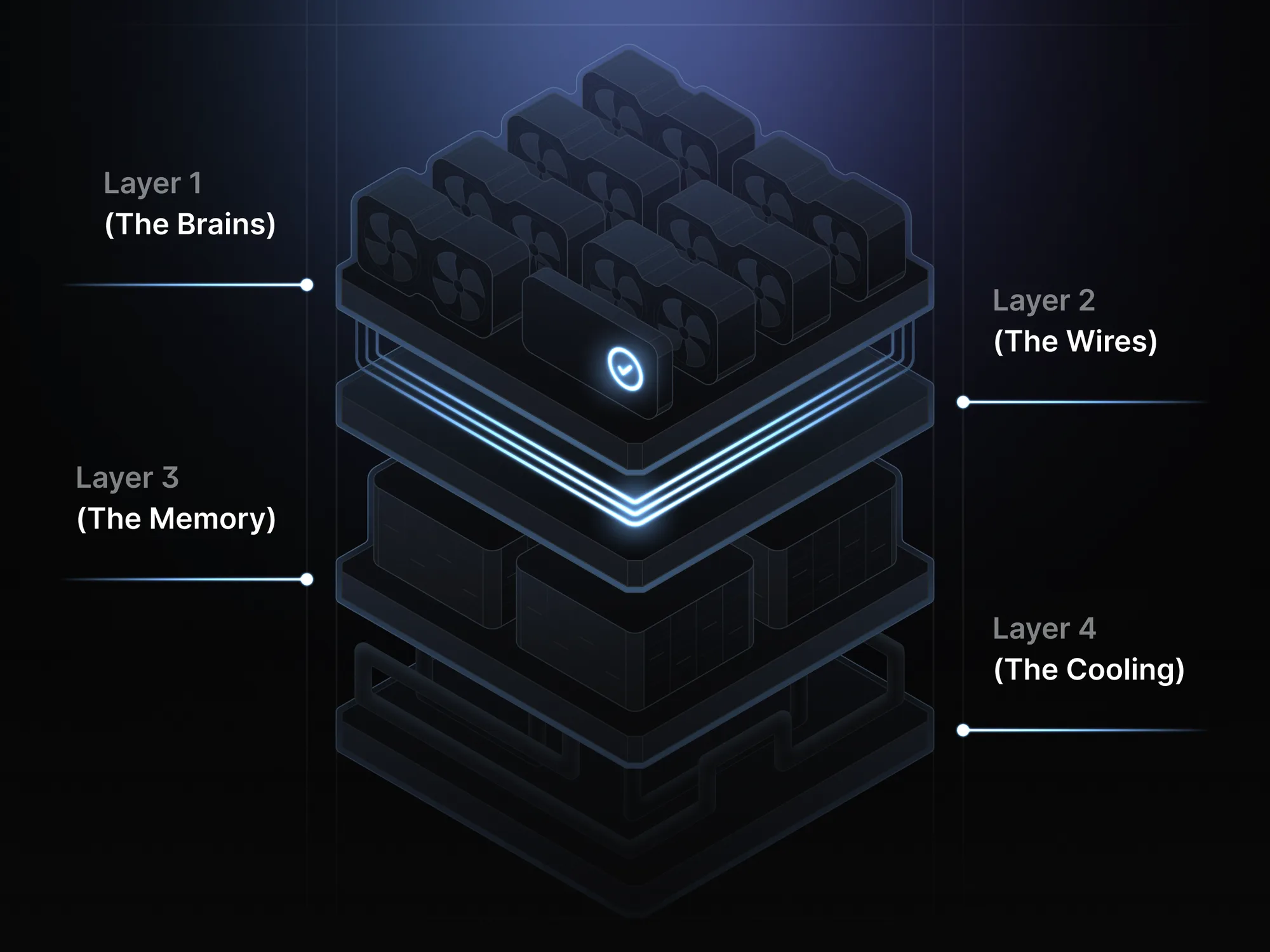
An AI data center represents a fundamental evolution in computing infrastructure, purpose-built to handle the intensive computational requirements of artificial intelligence applications. While traditional data centers optimize for general-purpose computing and web hosting, AI data centers focus exclusively on high-performance parallel processing capabilities that modern AI workloads demand.
The critical distinction lies in both scale and specialization. Training large language models with billions of parameters requires orders of magnitude more processing power than running traditional enterprise applications. At the core of every AI data center are GPU (Graphics Processing Unit) and TPU (Tensor Processing Unit) clusters—specialized processors designed to perform massive numbers of parallel calculations at incredible speed.
These processors enable complex tasks such as natural language processing, computer vision, and generative AI applications to run efficiently at scale. Unlike traditional CPU-based infrastructure, AI data centers process millions of mathematical operations simultaneously across distributed hardware, dramatically reducing training times and enabling real-time AI inference at global scale.
Advanced Cooling Systems for High-Performance Computing
The computational intensity of AI workloads generates extreme heat that overwhelms traditional air conditioning systems used in conventional data centers. AI data centers implement sophisticated cooling technologies designed specifically for high-density computing environments where energy consumption can reach 50-100 kilowatts per rack—significantly higher than traditional server infrastructure.
- Liquid cooling systems circulate specialized coolant directly through server components, enabling more efficient heat removal than air-based systems while reducing overall energy consumption by 20-30 percent compared to traditional cooling methods.
- Immersion cooling technology submerges entire servers in dielectric fluid, providing superior heat dissipation for the most demanding AI workloads while enabling unprecedented compute density per square foot of facility space.
- Precision air conditioning with targeted cooling zones ensures optimal operating temperatures for GPU clusters, which are particularly sensitive to thermal variations that can impact performance and hardware reliability.
- Hot and cold aisle containment architectures optimize airflow patterns specifically for high-density computing environments, preventing hot air recirculation and improving cooling efficiency across the entire facility.
These advanced cooling systems are essential for maintaining the reliability and performance of AI infrastructure while managing energy consumption costs that can represent 30-40 percent of total operational expenses.
Storage Systems Optimized for AI Applications
AI workloads require specialized storage systems that handle the unique data access patterns of machine learning applications. Unlike traditional enterprise applications that access small amounts of data frequently, AI training jobs process massive datasets in sequential batches while maintaining random access to model parameters and intermediate calculations.
Modern AI data centers implement multi-tiered storage architectures that optimize both performance and cost-effectiveness:
- NVMe SSD arrays provide ultra-low latency access to active training datasets, enabling rapid data ingestion during distributed training jobs where storage bottlenecks can significantly impact overall system performance.
- High-capacity object storage systems house massive dataset repositories and model checkpoints, providing scalable storage that can grow with expanding AI applications and longer-term data retention requirements.
- Parallel file systems distribute data across multiple storage nodes, enabling the massive throughput required for large-scale distributed training where hundreds or thousands of GPUs need simultaneous access to training data.
- Intelligent data tiering automatically moves information between high-performance and archival storage based on access patterns and project lifecycle requirements, optimizing storage costs while ensuring data availability when needed for model development and experimentation.
This sophisticated approach to storage systems enables AI data centers to support the demanding I/O requirements of modern AI workloads while managing storage costs that can represent a significant portion of total infrastructure expenses.
Infrastructure Demands of Modern AI Workloads
AI Training vs. Inference: Understanding Different Requirements
The infrastructure demands of AI data centers vary dramatically between model training and inference phases, requiring flexible systems that can optimize for both computational patterns. Understanding these distinct requirements is crucial for organizations planning their AI infrastructure investments and machine learning operational strategies.
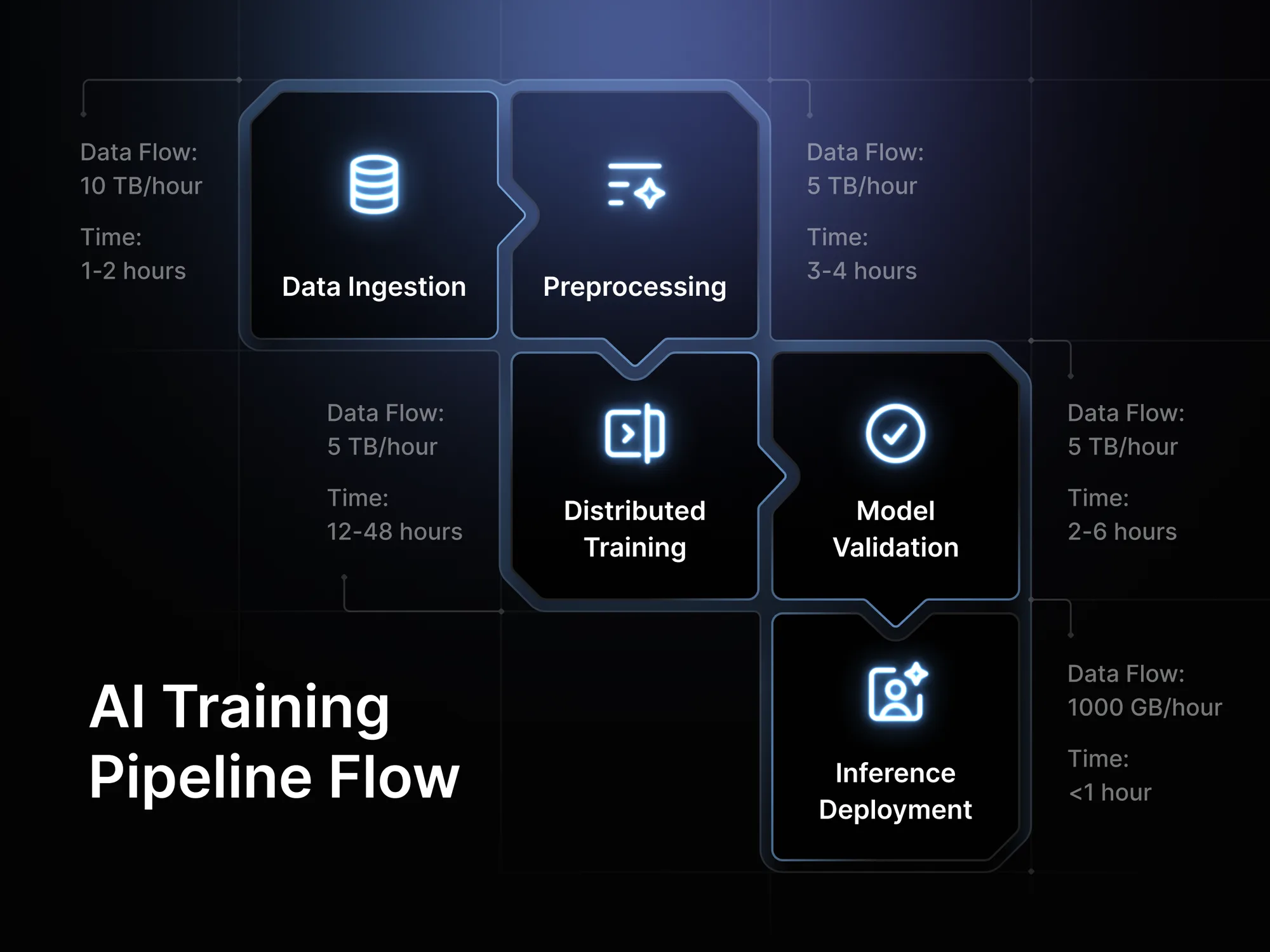
AI training workloads represent the most demanding phase of the AI lifecycle, requiring distributed computing across hundreds or thousands of high-performance GPUs working in parallel coordination. Training large language models or sophisticated neural networks can consume 10,000+ GPU hours and cost hundreds of thousands of dollars in compute resources for a single model development cycle.
During AI training, systems must process massive datasets while continuously updating billions of model parameters, requiring sustained high-performance computing over extended periods that can last weeks or months. The computational intensity generates substantial heat and consumes enormous amounts of energy, with training runs for state-of-the-art models consuming megawatts of power continuously.
AI inference workloads present different infrastructure challenges. They require consistent low-latency responses to serve millions of users simultaneously with real-time AI applications. While individual inference requests consume less compute power than training operations, the aggregate demand for serving AI applications at scale creates different stress patterns on infrastructure systems.
Inference operations prioritize response time and availability over raw computational throughput, requiring infrastructure optimized for consistent performance rather than peak processing power.
*Discover how decentralized compute networks are addressing these scaling challenges by distributing workloads across global GPU resources, reducing costs while maintaining the high-performance requirements of both training and inference operations.
Memory and Bandwidth Requirements for AI Applications
Modern AI applications push memory and bandwidth requirements to unprecedented levels that traditional data center infrastructure cannot support effectively. The scale of contemporary AI models demands sophisticated approaches to memory management and network connectivity that represent significant investments in specialized hardware and infrastructure.
Memory requirements for AI workloads have grown exponentially as models increase in complexity and capability. Large language models with billions of parameters require enormous amounts of high-bandwidth memory (HBM) to store model weights, intermediate calculations, and training data during processing phases. A single high-end AI server can require 80-320GB of GPU memory, with multi-node distributed training jobs requiring terabytes of coordinated memory across hundreds of interconnected systems.
Memory bandwidth becomes as important as total capacity, with AI workloads requiring sustained memory throughput that can exceed several terabytes-per-second across distributed training systems. This drives the adoption of specialized memory technologies like HBM3 that provide both high capacity and extreme bandwidth to support demanding AI applications.
Network bandwidth requirements become critical for distributed AI training, where model parameters must be synchronized across hundreds or thousands of GPUs multiple times per second during training processes. AI data centers implement high-speed networking fabrics, infrastructure designed to ensure rapid communication and to prevent bottlenecks, capable of 400Gbps or higher throughput with microsecond-level latency.
The networking infrastructure must also support the massive data movement required for loading training datasets, saving model checkpoints, and coordinating distributed training across multiple nodes. These requirements drive adoption of advanced networking technologies like InfiniBand and high-speed Ethernet that can sustain the extreme bandwidth demands of large-scale AI workloads.
Scaling AI Infrastructure for Exponential Growth
The rapid pace of AI model development demands infrastructure that can scale dynamically to meet exponentially growing computational requirements. Organizations routinely experiment with models exceeding 100 billion parameters, requiring exascale compute power that can expand or contract based on evolving project needs and research directions.
Traditional capacity planning approaches prove inadequate in AI environments where resource requirements can change by orders of magnitude between different projects, model architectures, and training approaches. A research project that requires modest computational resources for initial experimentation might suddenly need 10x or 100x more resources when scaling to larger datasets or more sophisticated model architectures.
Elastic scaling capabilities must accommodate these dramatic fluctuations while maintaining cost efficiency and performance consistency. This requires sophisticated resource management systems that can dynamically allocate GPU clusters, storage systems, and networking resources based on real-time demand patterns and predictive analytics.
The scaling challenge extends beyond just raw computational resources to include supporting infrastructure like cooling systems, power distribution, and network connectivity. As AI workloads scale up, the supporting infrastructure must scale proportionally to maintain optimal operating conditions and prevent bottlenecks that could limit overall system performance.
*Explore how distributed computing approaches enable more flexible scaling by spreading workloads across multiple geographic regions and infrastructure providers, reducing dependence on single facilities while providing cost-effective access to massive computational resources when needed for large-scale AI projects.
Geographic Hotspots: Where AI Infrastructure Thrives
Northern Virginia: America's Dominant AI Infrastructure Hub
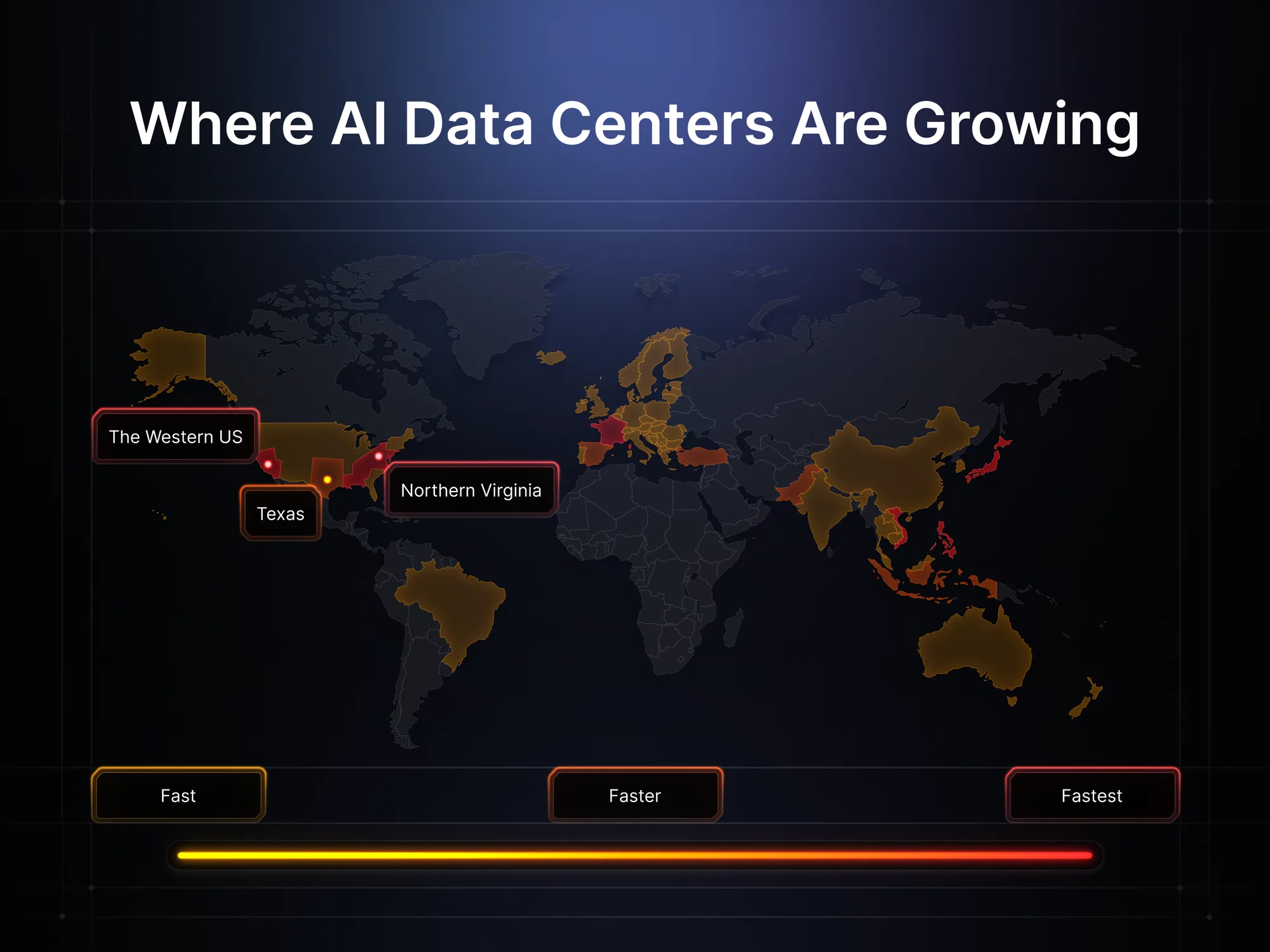
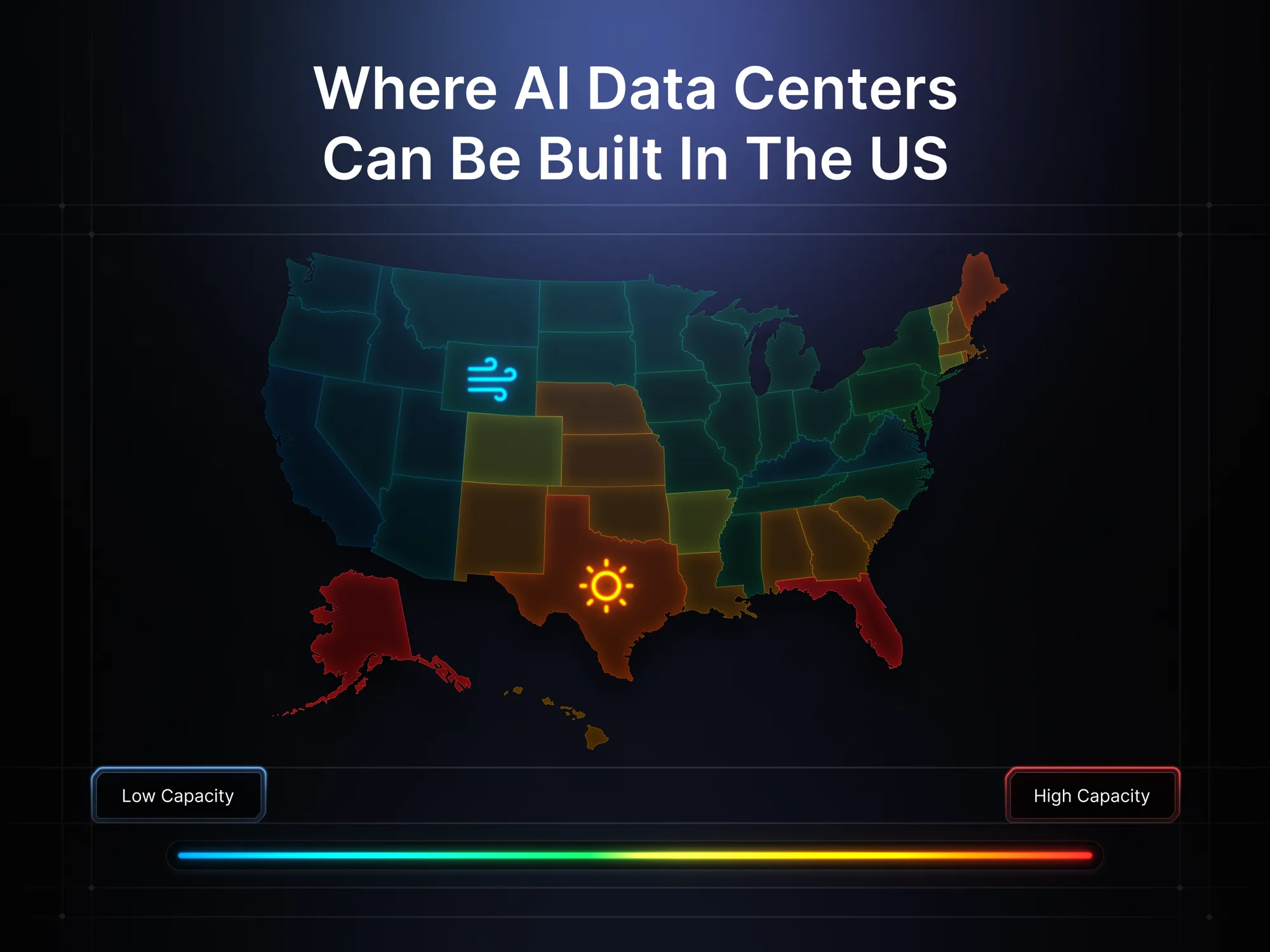
Northern Virginia has emerged as the undisputed leader in AI data center infrastructure across the United States, housing facilities that process a significant percentage of global AI workloads and serving as the backbone for major AI applications worldwide. This concentration of AI infrastructure represents one of the most significant technological infrastructure developments in recent decades.
The region's dominance stems from unique advantages that created optimal conditions for large-scale AI data center development. Northern Virginia benefits from extensive fiber optic connectivity infrastructure, reliable electrical grid access capable of supporting massive power requirements, and strategic proximity to major telecommunications hubs and internet exchange points.
Historical internet infrastructure development provided the foundational layer, with early investments in networking and connectivity creating the ecosystem that now supports cutting-edge AI research and commercial AI applications. The region's established data center corridor, often referred to as "Data Center Alley," provides a mature ecosystem of supporting services, a specialized workforce, and regulatory frameworks optimized for large-scale digital infrastructure.
Power grid infrastructure represents one of Northern Virginia's most critical advantages for AI data center development. Regional utilities can reliably deliver the 50-100+ megawatts required by large-scale AI facilities, with grid stability and redundancy essential for supporting continuous AI training operations that cannot tolerate power interruptions.
The concentration effect has created a self-reinforcing ecosystem where existing AI infrastructure attracts additional investment, specialized suppliers, skilled technical workforce, and supporting services. This ecosystem advantage makes Northern Virginia increasingly attractive for organizations requiring access to large-scale, reliable AI infrastructure for both research and commercial applications.
Western United States: High-Performance Computing Growth Amid Resource Constraints
The western United States has experienced rapid AI data center expansion, particularly in Nevada, Arizona, and parts of California, driven by proximity to major technology companies and favorable business environments. However, this growth pattern exposes significant resource constraints that highlight the sustainability and scalability challenges of AI infrastructure development at scale.
Water consumption represents the most pressing constraint for AI data center expansion in western regions. AI data centers require millions of gallons of water daily for cooling systems, creating significant tension in drought-prone areas where water resources are already stressed by population growth and climate change impacts.
Large AI facilities can consume 3-5 million gallons of water per day for cooling operations, equivalent to the water consumption of a small city. This massive water requirement conflicts with conservation efforts in states like California, Nevada, and Arizona, where water availability is a critical long-term sustainability concern.
Electrical grid capacity presents another significant challenge, as power grids in many western states already struggle with peak demand during summer months. AI data centers add substantial baseload demand that operates continuously 24/7, requiring reliable access to 50-100 megawatts or more per facility.
The high energy consumption of AI workloads, combined with growing residential and commercial electricity demand, is straining grid infrastructure and raising concerns about reliability during peak usage periods. Some regions have experienced delays in AI data center development due to inadequate electrical grid capacity and lengthy utility upgrade timelines.
Despite these resource constraints, western states continue attracting AI infrastructure investment due to several advantages: proximity to major technology companies headquartered in Silicon Valley and Seattle, access to renewable energy sources including solar and wind power, and favorable business climates with supportive regulatory frameworks.
*Explore how distributed computing approaches are helping address regional resource constraints by spreading AI workloads across multiple geographic areas, reducing strain on individual regions while maintaining high-performance capabilities required for demanding AI applications.
Energy Consumption Patterns and Sustainability Challenges
The energy consumption profile of AI data centers represents one of the most significant infrastructure challenges of the AI revolution, with implications for both operational costs and environmental sustainability. Understanding these consumption patterns is crucial for organizations planning AI infrastructure investments and policymakers developing energy regulations.
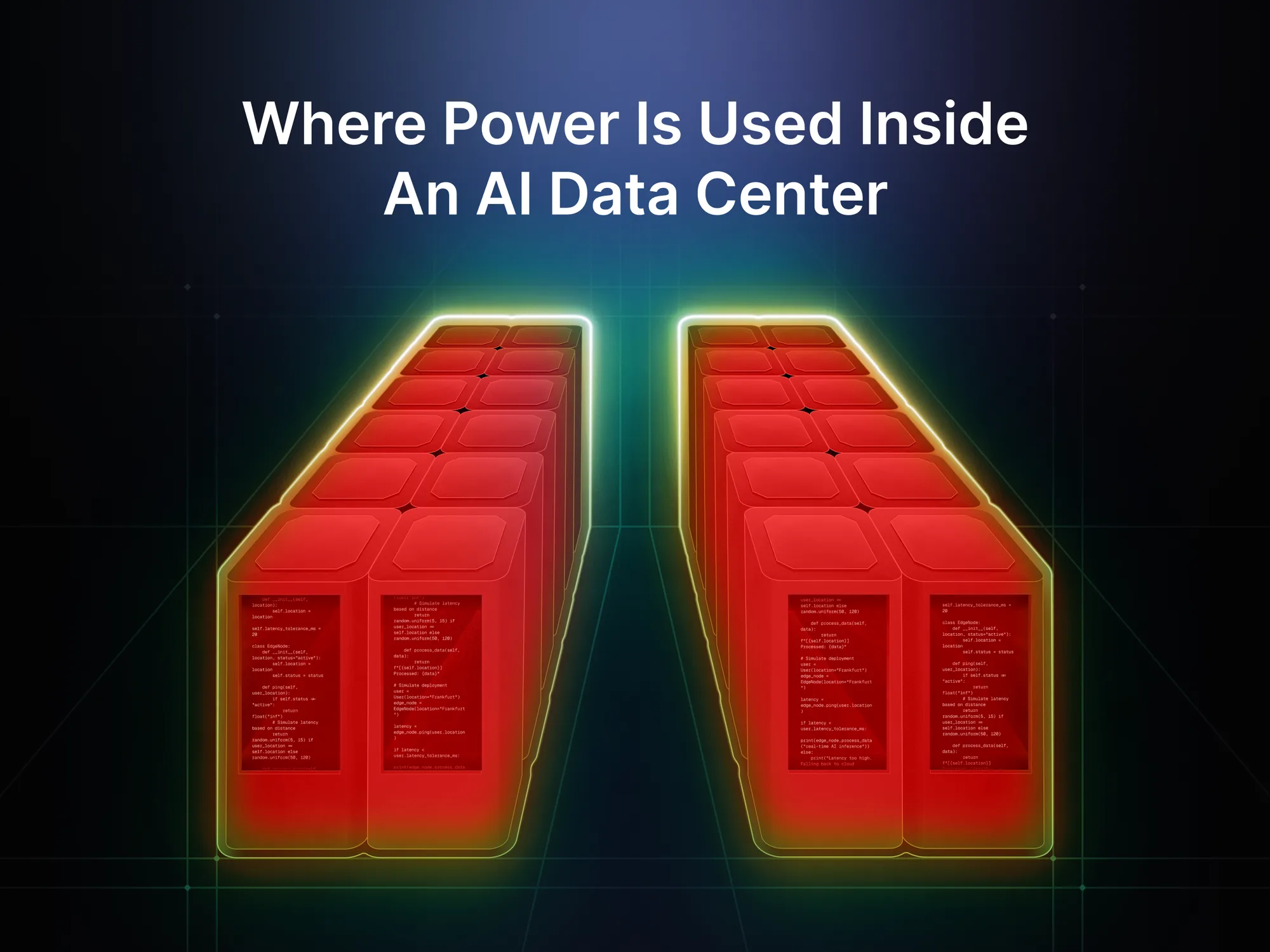
Power consumption scaling in AI data centers follows exponential patterns that correlate directly with model complexity and training requirements. A single large-scale AI training run can consume 1-10 megawatts continuously for weeks or months, equivalent to the power consumption of thousands of homes operating simultaneously.
The most advanced AI training operations require sustained power consumption that can reach 50-100 megawatts per facility, comparable to small industrial manufacturing plants. This massive energy requirement is driving innovations in power distribution, backup systems, and grid integration to ensure reliable operations for mission-critical AI workloads.
Energy efficiency improvements are becoming essential for managing operational costs and environmental impact. Modern AI data centers achieve power usage effectiveness (PUE) ratios of 1.1-1.3—meaning that for every watt consumed by computing equipment, only 0.1-0.3 additional watts are consumed by cooling and supporting infrastructure.
Advanced cooling technologies, including liquid cooling and immersion cooling systems, can reduce overall energy consumption by 20-30 percent compared to traditional air-cooling approaches while enabling higher compute density per square foot of facility space.
Renewable energy integration is becoming a strategic priority for AI data center operators seeking to manage energy costs and meet sustainability commitments. Many facilities are investing in on-site solar installations, wind power agreements, and grid-scale battery storage to offset the massive energy consumption of AI workloads.
The challenge of managing energy consumption at scale is driving development of AI-powered energy optimization systems that can automatically adjust cooling, compute allocation, and power distribution to minimize total energy usage while maintaining performance requirements for AI applications.
Global Competition and Emerging International Markets
International regions are rapidly developing competitive AI infrastructure capabilities to capture economic benefits and reduce dependence on US-based facilities. The Middle East leverages oil wealth to fund massive AI infrastructure projects as part of economic diversification strategies.
European countries emphasize sustainability and data sovereignty, implementing strict environmental standards while building AI capabilities. Asia-Pacific regions focus on serving local markets while developing export capabilities, creating new competitive dynamics in the global AI infrastructure landscape.
Comprehensive AI Data Center Services
Compute Provisioning and Resource Management
Modern AI data centers provide comprehensive compute provisioning that goes beyond basic server rental. Advanced scheduling systems optimize resource allocation across multiple concurrent workloads while ensuring consistent performance for critical applications.
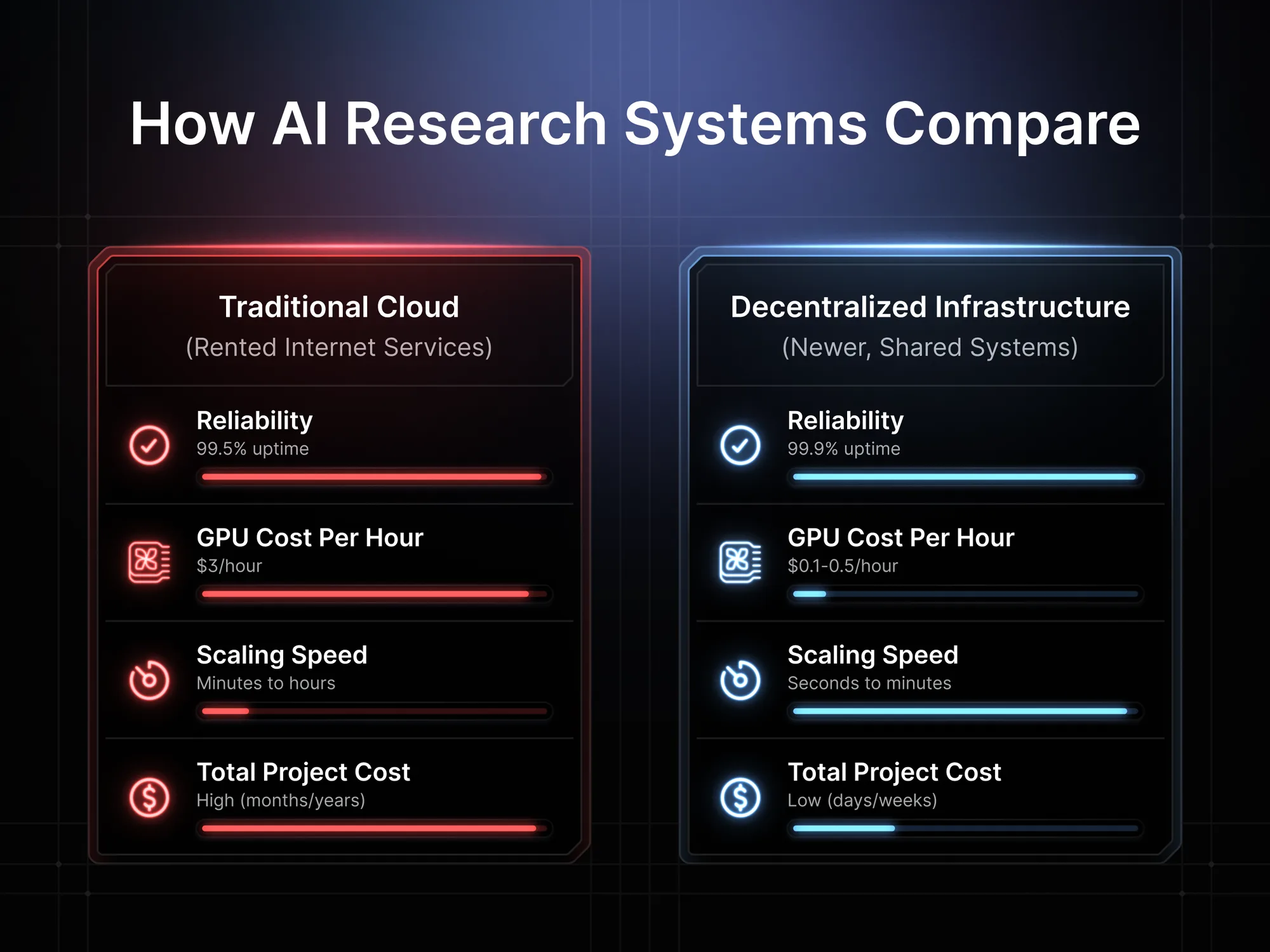
On-demand provisioning allows organizations to access massive GPU clusters for short-term projects, while reserved capacity provides guaranteed resources for long-term training initiatives. VOLT's decentralized approach enables flexible compute provisioning with significant cost advantages over traditional cloud providers. Intelligent workload placement automatically optimizes resource utilization by analyzing job requirements and available capacity across the facility.
This ensures maximum efficiency while maintaining performance guarantees for mission-critical workloads.
Storage Systems Optimized for AI
AI workloads require specialized storage architectures that handle unique access patterns of machine learning applications. Parallel file systems provide massive throughput for training data ingestion, supporting the high-bandwidth requirements of distributed training jobs.
Automated data tiering moves information between high-performance and archival storage based on access patterns and project lifecycle stages. This approach optimizes costs while ensuring data availability when needed for model development and experimentation.
Networking and Interconnect Technologies
Advanced networking fabrics enable the distributed computing essential for large-scale AI training. High-bandwidth, low-latency interconnects ensure communication bottlenecks don't limit GPU performance during parameter synchronization across distributed training jobs.
InfiniBand and Ethernet networking solutions provide the bandwidth and latency characteristics required for efficient distributed AI workloads. Network optimization specifically for AI traffic patterns ensures maximum utilization of available compute resources.
AI-Powered Infrastructure Management
Intelligent Monitoring and Optimization
AI data centers increasingly leverage artificial intelligence to manage their own infrastructure, creating a recursive application of machine learning to infrastructure optimization. AI-powered monitoring systems analyze real-time telemetry from thousands of sensors throughout the facility to predict failures, optimize resource allocation, and automate routine maintenance tasks.
Predictive maintenance capabilities powered by machine learning algorithms analyze historical performance data to identify equipment degradation before it causes expensive downtime. These systems can predict cooling system failures, storage device degradation, and network congestion with remarkable accuracy.
*Discover how AI-driven infrastructure management is revolutionizing data center operations by enabling partially self-managing facilities that optimize performance and efficiency automatically.
Energy Management and Sustainability
Machine learning-based energy optimization represents one of the most impactful applications of AI to infrastructure management. These systems continuously analyze power consumption patterns across all infrastructure components and automatically adjust operations to minimize energy usage while maintaining performance requirements.
Real-time load balancing algorithms distribute workloads across the facility to optimize energy efficiency, taking into account factors like cooling requirements, power distribution, and equipment utilization. Advanced systems can reduce overall energy consumption by 15-25% while maintaining or improving performance levels.
Automated Resource Allocation
Intelligent resource allocation systems use machine learning to analyze historical usage patterns and predict future demand, automatically provisioning resources before bottlenecks occur. These systems consider factors like model complexity, dataset size, and training duration to optimize resource allocation decisions.
Dynamic scaling capabilities enable facilities to respond to changing demand patterns in real-time, ensuring optimal resource utilization while meeting performance guarantees. This automation reduces human error while enabling more efficient operations at scale.
Real-World Success Stories
Academic Research Breakthrough: A Robotics Team Partnership
A collaboration between a robotics team, a university's RAIL Lab, and VOLT demonstrates the transformative potential of purpose-built AI infrastructure for advancing academic research. The partnership tackled the challenge of validating crowdsourced navigation datasets through intensive computational analysis, which required consistent, long-term access to .
Traditional cloud infrastructure proved inadequate due to frequent preemptions and scaling delays that disrupted long-running experiments. The research required processing 2TB of navigation data through continuous training runs spanning multiple weeks—a workload that demanded infrastructure reliability beyond what conventional providers could deliver.
Through VOLT's decentralized AI infrastructure, the collaboration achieved remarkable results over 66 days. The infrastructure supported 12,696 total GPU hours, including a continuous 10-day training run across 8 GPUs without interruption. When additional storage capacity was needed, the team provisioned 5TB of local storage in 30 minutes,compared to days with traditional providers.
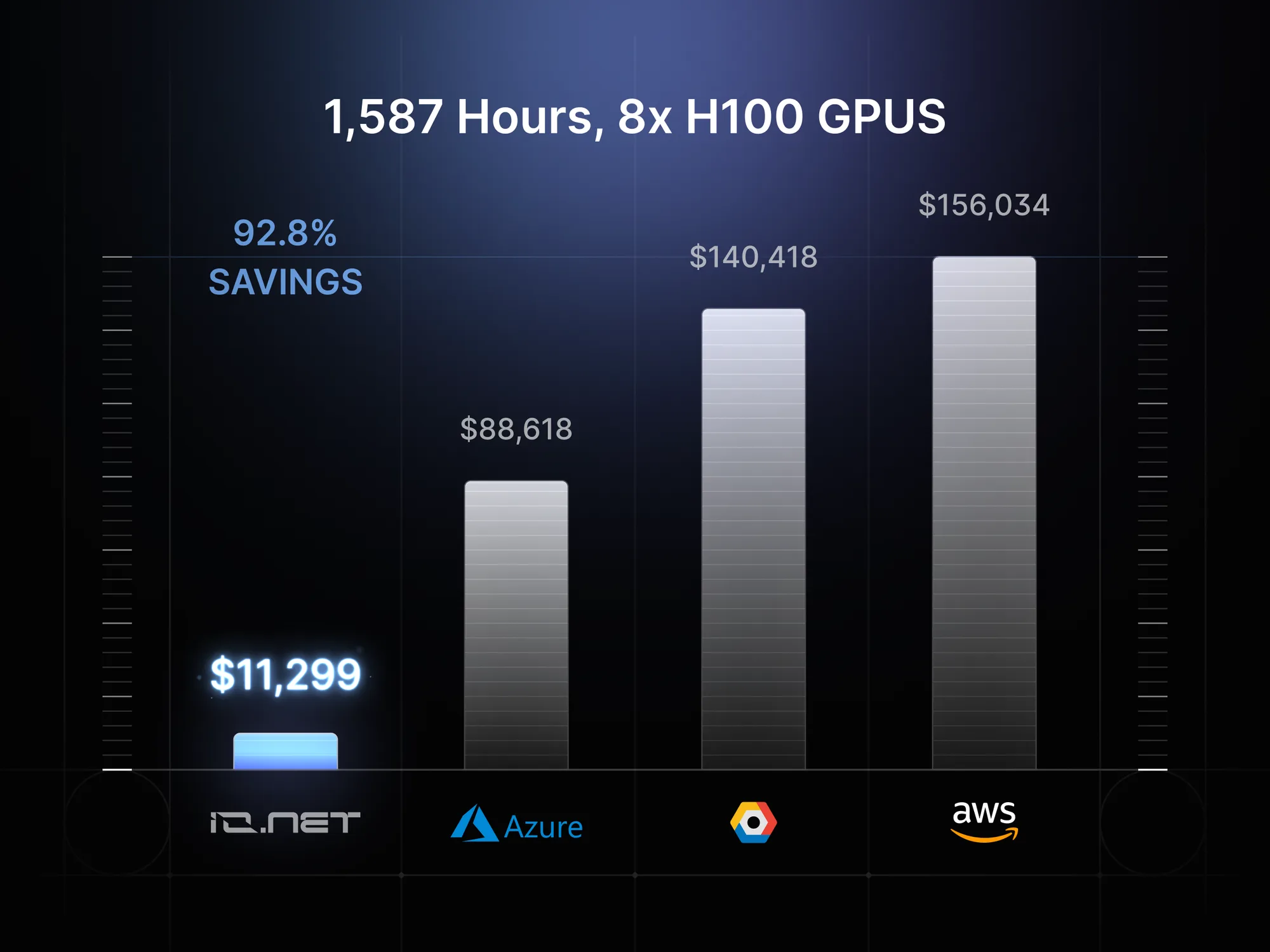
The research breakthrough validated the team's navigation approach, improving materially on the baseline methods. Most significantly, the partnership delivered a large share cost savings compared to AWS pricing, making advanced AI research economically accessible to academic institutions.
Autonomous AI Agents: Zerebro's Ethereum Validation
The partnership between VOLT and Zerebro showcases how AI data centers support autonomous AI agents entering blockchain validation. Zerebro, an autonomous AI agent, leveraged globally distributed infrastructure to enhance Ethereum validator operations while maintaining creative and technical capabilities.
This collaboration demonstrates the growing synergy between decentralized infrastructure and autonomous agents in web3 environments. Zerebro can access vast GPU resources on demand through VOLT's permissionless network, ensuring reliability and scalability for blockchain validation while supporting exploration of novel AI applications.
The partnership bridges AI innovation with blockchain security, as autonomous agents expand beyond original creative functions into critical infrastructure roles. By utilizing versatile GPU clusters, Zerebro maintains operational sustainability while generating revenue through validation activities.
Key Success Factors
These real-world implementations reveal critical factors for successful AI infrastructure deployments. Reliability emerged as the paramount concern, with continuous uptime enabling breakthrough research impossible with traditional preemption models. The ability to sustain long-running experiments—such as the 10-day continuous training run—proves fundamental to advancing complex AI research.
Cost efficiency through strategic partnerships can dramatically change economic feasibility, as demonstrated by the large share cost savings achieved through decentralized infrastructure. This level of cost reduction transforms accessibility of high-end AI research, enabling institutions to pursue ambitious projects previously reserved for well-funded corporations.
Responsive scaling capabilities proved essential for dynamic research needs, with infrastructure providers demonstrating ability to provision additional resources in minutes rather than days. These partnerships illustrate how flexible, cost-effective infrastructure increasingly determines the pace of AI development and innovation.
Industry Recognition and Future Trends
Sustainability and Innovation Awards
The AI data center industry has garnered significant recognition for innovations in sustainability, design, and technological advancement. Leading facilities achieve power usage effectiveness (PUE) ratios below 1.2 while maintaining high-performance AI workload support through innovative cooling technologies and renewable energy integration.
Design excellence recognition honors facilities that successfully balance performance, efficiency, and scalability demands. Technology innovation awards highlight breakthrough implementations of AI-powered infrastructure management, representing cutting-edge applications of artificial intelligence to manage AI infrastructure itself.
Emerging Technologies and Future Directions
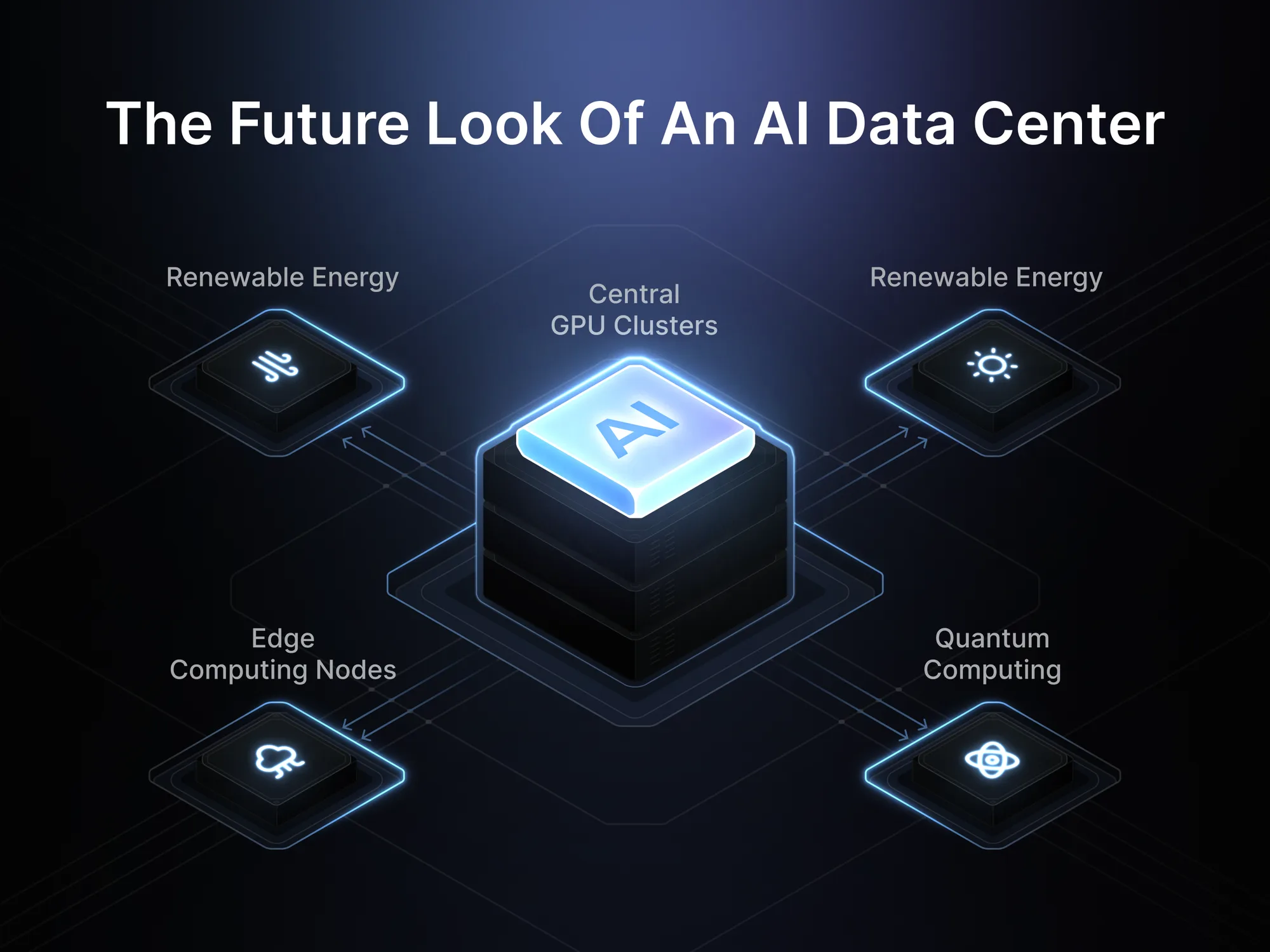
The convergence of edge computing with centralized AI data centers is creating new architectural possibilities that bring AI capabilities closer to end users while maintaining scale advantages of centralized infrastructure. This hybrid approach enables real-time AI applications with minimal latency while leveraging powerful centralized resources for complex processing tasks.
Quantum computing integration represents a longer-term possibility that may eventually transform AI data center architectures. While still experimental, quantum-classical hybrid systems could provide breakthrough capabilities for specific AI workloads, particularly in optimization and machine learning applications.
Building the Foundation for AI Success
The evolution of AI data centers represents a fundamental transformation in digital infrastructure, comparable to the original internet backbone development in the 1990s. As artificial intelligence continues permeating every aspect of business operations, the infrastructure powering these capabilities becomes increasingly critical to economic competitiveness and innovation leadership.
Organizations preparing for this future must recognize that AI infrastructure decisions made today will shape their competitive position for years to come. The rapid pace of AI model development, combined with exponential growth in computational requirements, demands infrastructure strategies that are both ambitious and adaptable to evolving needs.
Companies investing in appropriate AI data center partnerships and capabilities now will be positioned to capitalize on AI opportunities as they emerge, while those that delay may find themselves constrained by inadequate infrastructure. The sustainability challenge represents both obstacle and opportunity, driving innovation in energy efficiency, renewable energy integration, and advanced cooling technologies that benefit the entire technology sector.
The geographic distribution of AI data center capabilities is reshaping global technology leadership. Countries and regions investing in AI infrastructure today build the foundation for future AI dominance, while those that lag risk technological dependence on foreign infrastructure. This dynamic drives significant public and private investment worldwide, creating opportunities for businesses that can navigate this evolving landscape effectively.
Looking ahead, the convergence of edge computing with centralized AI data centers will create new architectural possibilities that bring AI capabilities closer to users while maintaining scale advantages. The integration of emerging technologies like quantum computing may eventually transform architectures again, though this remains a longer-term possibility.
For organizations planning AI strategies, the key is partnering with experts who understand both current capabilities and future trends. The complexity of AI infrastructure requires specialized expertise that most organizations cannot develop internally. By choosing the right partners and infrastructure strategies today, organizations can build the foundation for AI success while maintaining flexibility to adapt as technologies and requirements evolve.
The future belongs to organizations that can effectively harness AI capabilities, and AI data centers provide the critical infrastructure foundation that makes this possible. The time to begin preparing for this future is now, before competitive pressures and resource constraints make optimal choices more difficult to achieve.
Frequently Asked Questions
What distinguishes AI data centers from traditional facilities?
AI data centers are purpose-built for artificial intelligence workloads, featuring specialized hardware optimized for parallel processing, advanced cooling systems for high-density computing, networking designed for distributed computing, and storage architectures optimized for AI data access patterns. Traditional data centers focus on general-purpose computing, while AI facilities optimize specifically for machine learning operations.
How do AI data centers address energy consumption concerns?
Modern AI data centers implement advanced energy management technologies including liquid cooling systems that reduce consumption by 20-30%, renewable energy integration, and AI-powered optimization systems that automatically adjust operations for maximum efficiency. Many facilities achieve carbon neutrality through renewable energy sourcing and efficiency measures.
Why has Northern Virginia become the AI data center capital?
Northern Virginia's dominance results from extensive fiber optic connectivity, reliable electrical grid access with capacity for large-scale facilities, favorable regulatory environment, and a self-reinforcing ecosystem that attracts specialized suppliers and a skilled workforce. Historical internet infrastructure development provided the foundation for current AI infrastructure leadership.
Which industries benefit most from AI data centers?
Healthcare organizations utilize AI infrastructure for medical imaging analysis and drug discovery acceleration. Financial services leverage AI data centers for fraud detection, algorithmic trading, and risk assessment. Technology companies rely on AI infrastructure for consumer applications, while automotive, media, and manufacturing industries use AI capabilities for autonomous vehicles, content creation, and predictive maintenance.
What are typical costs for AI data center services?
GPU compute resources typically cost $1-10 per GPU-hour depending on hardware specifications and utilization patterns, with storage costs ranging from $0.02-0.20 per GB per month. Total project costs can range from thousands for small experiments to millions for large-scale model training, making cost optimization through strategic partnerships critical for economic viability.
How can organizations prepare for future AI infrastructure needs?
Organizations should evaluate current AI workload requirements and growth projections, assess cost-effectiveness of different infrastructure approaches, consider hybrid solutions that combine multiple resource types, and partner with providers who understand both current capabilities and future trends. The complexity of AI infrastructure requires specialized expertise most organizations cannot develop internally.
Ready to optimize your AI workloads with cutting-edge data center infrastructure? Explore how modern decentralized AI infrastructure can transform your organization's capabilities while supporting sustainable and cost-effective operations.