Try VOLT Intelligence
Get StartedTry VOLT Cloud
Deploy GPUTable of Contents
- Overview
- Technical and Cost Bottlenecks
- Enter: VOLT Cloud Infrastructure
- Timeline of An AI Music Platform’s Transition to VOLT
- Measuring An AI Music Platform’s VOLT Integration
- Inside An AI Music Platform’s Technical Architecture with VOLT
- Impact on An AI Music Platform’s Business Model
- Key Takeaways from An AI Music Platform’s VOLT Integration
Overview
, a generative AI music startup making music creation globally accessible, wanted to build intelligent agents for end-to-end music creation. Backed by outside funding, it was building what its CEO described as “an AI agent for music that handles everything from ideation and production to editing and distribution.”
As with many AI startups, the global 12-person team was immediately confronted with a problem that made scaling so difficult for an AI music platform: the prohibitive costs of compute and collaborating across continents.
Training AI models capable of generating, separating, and transforming audio at studio-quality levels was quickly burning through an AI music platform’s warchest. To make matters worse, neither of their two main cloud compute options was flexible enough to support collaboration on the model between both of their U.S. and China-based teams.
This is the story of how an AI music platform remixed their approach to compute infrastructure so that they could power their generative AI music platform.
300K+ GPUs ready when you are
Global decentralized network across 138 countries. Scale training and inference workloads without centralized bottlenecks.
Technical and Cost Bottlenecks
From the start, the AI music platform team faced a combination of financial and technical bottlenecks. To train their AI, workflows were required that demanded massive parallel processing, custom GPU setups, and high-speed storage. Current solutions, however, were not only expensive but also rigid.
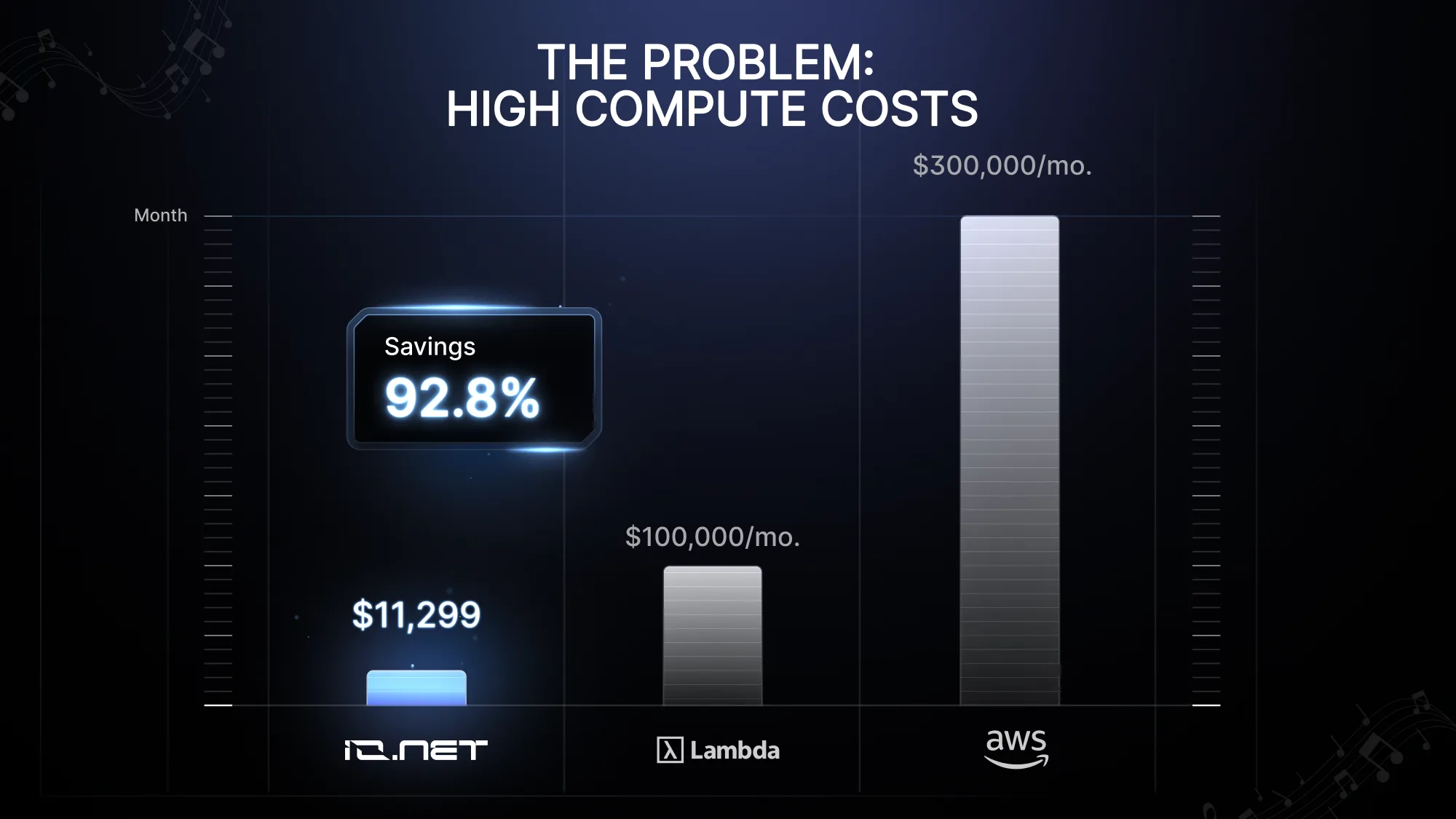
an AI music platform’s monthly compute costs exceeded $100,000 on Lambda Labs. If the company had switched to AWS, the CEO said that pricing would have been “three times that" figure—or, $300,000 per month.
Even worse, neither platform could accommodate the team’s need for custom GPU clusters optimized for multi-model training. Data transfer speeds were insufficient for handling massive music datasets, and limited storage options created constant bottlenecks in their training pipeline.
Global collaborative challenges also proved difficult to overcome. an AI music platform’s China-based research team often experienced latency and connectivity issues, delaying experimentation and slowing model iteration cycles.
“Costs were spiraling, storage was too slow, and global collaboration was suffering,” said the CEO.
By early 2024, an AI music platform’s total compute spend surpassed $1.3 million. Leadership knew that to continue building high-quality models, they would need a partner that offered both compute affordability and technical freedom.
Enter: VOLT Cloud Infrastructure
an AI music platform found their compute partner in VOLT, enabling the team to reimagine and redesign its infrastructure around cost efficiency, scalability, and customization.
"At its peak, we had 96 GPUs running,” noted the CEO. “We had 64 H100s and 32 H200s."
All of this was provisioned using VOLT Cloud in less than 24 hours. With 100GB-per-second data transfer speeds, an AI music platform’s global teams could now move training data between regions in real time, enabling continuous collaboration across the U.S. and China.
Over a six-month period, an AI music platform consumed hundreds of thousands of GPU hours at a total cost of $1.24 million—a 75% reduction compared to equivalent workloads on AWS. With aggressive pricing, instant scalability, and high-performance hardware, the team trained multiple proprietary models simultaneously without sacrificing speed or stability.
“Without VOLT, model development would’ve been delayed by months—or simply would not have possible at all,” said the CEO. “We needed cost efficiency and flexibility. VOLT gave us both.”
Timeline of An AI Music Platform’s Transition to VOLT
an AI music platform experienced both a rapid and transformative transition to VOLT. Initial integration kicked off in early 2024, with the first model training phase completed by March. By June, an AI music platform’s flagship AI music platform had launched using models trained entirely on VOLT infrastructure.
Over the ensuing months, the team continued scaling workloads and refining model performance. They also made preparations for international market expansion through VOLT Intelligence integration.
That said, the implementation process wasn’t without challenges.
Early stability issues required close coordination between an AI music platform’s engineers and the VOLT support team. Within a few weeks, however, performance had stabilized and throughput was fully optimized.
Ready to cut your AI costs by 70%?
Join 500+ companies already saving up to 70% on compute costs.
Measuring An AI Music Platform’s VOLT Integration
After officially launched in June 2024, the AI music platform team made measurable improvements measurable across every layer of the business. Using VOLT’s infrastructure, the team successfully trained three proprietary AI models:
- A music generation model trained on over 500,000 songs.
- A stem separation model that isolates instrument and vocal layers.
- A voice conversion model capable of transforming vocal tone and timbre.
With these three models powering the AI music platform, the company scaled to hundreds of thousands of users across 171 countries within four months. Even better, the company laid the foundation of a sustainable subscription business model, with pricing tiers ranging from $7 to over $100 per month. Annual recurring revenue reached $200,000, and user growth climbed at a rate of 50% month over month.
But these metrics only tell part of the story. an AI music platform’s partnership with VOLT gave the platform a critical strategic advantage: With faster model training and deployment, the company was able to move three months ahead of its own projected launch timeline.
As expected, investors responded positively to the new infrastructure foundation. an AI music platform had demonstrated that the platform could scale efficiently while continuing to support advanced research and development.
“Investors were thrilled to see we had a strong compute partner,” the CEO said. "It’s cost effective but it's also very important because not every startup is getting their own models. Most startups don't build models."
Inside An AI Music Platform’s Technical Architecture with VOLT
an AI music platform’s training pipeline now runs on a fully customized GPU configuration optimized for AI music workloads.
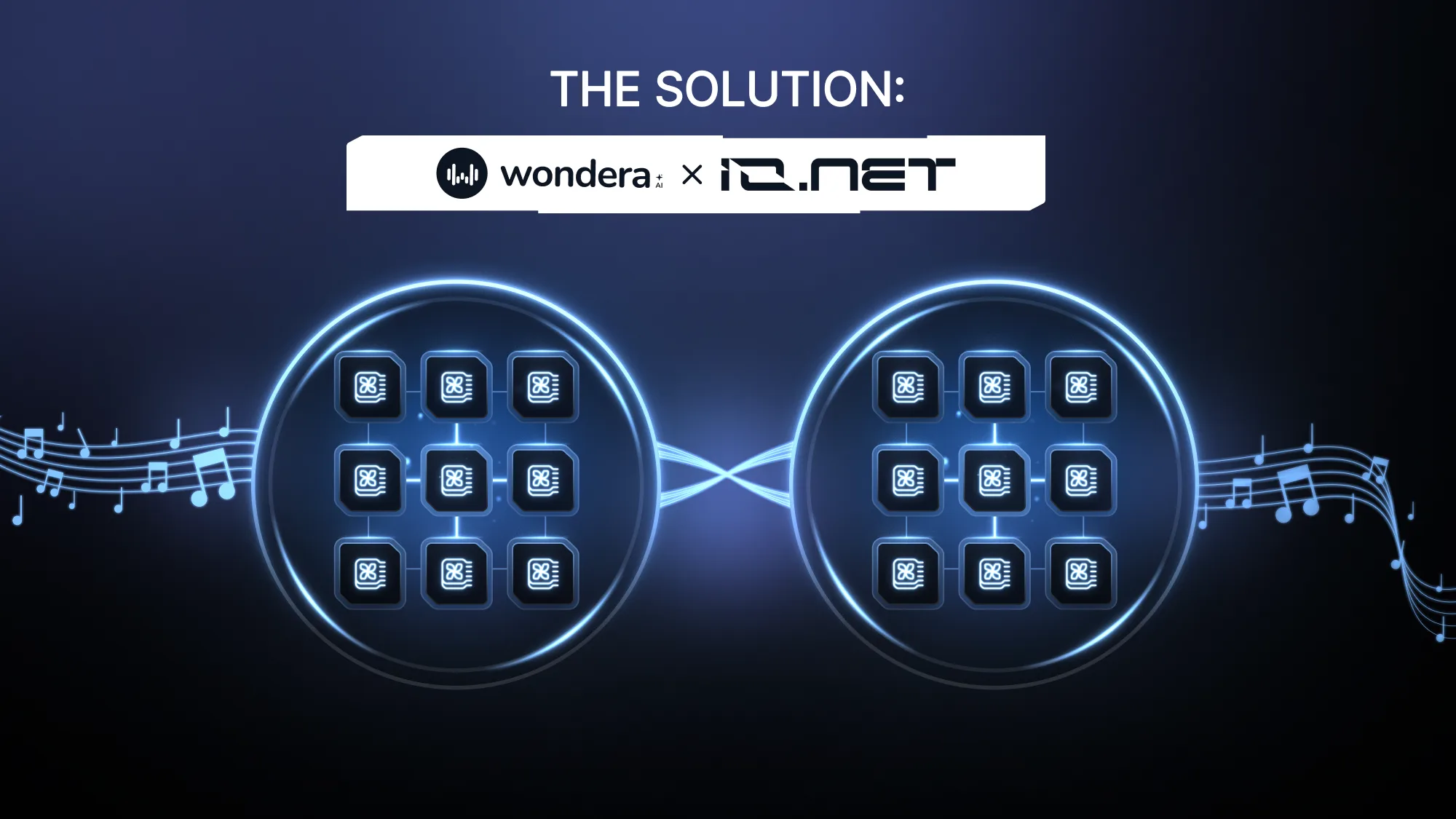
The company operates with eight-node clusters that combine A100 and H100 GPUs for parallelized training and high-throughput data handling. With 100GB/s bandwidth and near-instant provisioning, an AI music platform’s engineers can rapidly experiment, train, and deploy models without the friction of conventional cloud systems.
All told, an AI music platform logged hundreds of thousands of GPU hours across 180 days, from music generation and stem separation to voice conversion workflows.
This level of compute performance—delivered at one-quarter the cost of AWS or Azure—is now a cornerstone of an AI music platform’s ongoing R&D strategy.
Impact on An AI Music Platform’s Business Model
an AI music platform’s partnership with VOLT went beyond cost reduction, to include a major shift in an AI music platform’s product and growth trajectories. Reliable, affordable compute enabled the team to put its focus where it should be: on resources aimed at improving product features and expanding into new markets.
“We simply couldn’t have built these models anywhere else—not at this cost, not at this speed,” said the CEO.Beyond its consumer-facing product lineup, an AI music platform is now negotiating partnerships with major music labels that will offer AI-assisted production tools and voice transformation technology to professional artists and studios.
"We are going to create a new line of business to be more B2B for the music industry—a custom agent that can serve major labels and publishers,” the CEO explained. “[Labels and publishers] want the agent to help with creating derivatives from existing production music—they don't want the clients to use AI purely because pure AI has no copyright.”
the CEO also mentioned that an AI music platform is working on an agent music player. The idea is to compete with streaming music platforms—but with some novel features.
"The agent music player has no playlist and nothing to search or explore,” he said. “It's voice activated. It can also play some music, it can modify and edit music as it's playing.”
In the process, an AI music platform is solidifying its position as a leading innovator in AI-powered music creation. The company is also proving that generative AI music and audio can be done with decentralized compute — at scale.
Key Takeaways from An AI Music Platform’s VOLT Integration
an AI music platform’s success underscores how AI-native startups can realize massive cost savings as well as technical and collaborative acceleration without depending on costly, rigid cloud providers like Lambda Labs, AWS, and Azure.
Another path is now clear and proven: one where AI startups can leverage specialized compute infra from providers like VOLT.
This new path gives AI startups exactly what they need to launch and scale their platforms: affordability, scalability, and global connectivity. All of this enables cutting-music music AI models—and other AI models for that matter—to get to market faster at a fraction of traditional compute costs, and with more organizational flexibility.
Ready to slash your AI compute costs?
Join the growing wave of AI startups already saving up to 70% on compute costs.