AI Training vs Inference: Key Differences, Costs & Use Cases [2025]
Try VOLT Intelligence
Get StartedTry VOLT Cloud
Deploy GPUTable of Contents
- What Is AI Training?
- What is AI Inference?
- Key Differences Between AI Training and Inference
- Hardware Requirements: Training vs Inference
- Training Hardware Needs
- Inference Hardware Needs
- Cost Analysis: The Economics of Training vs Inference
- Upfront Training Costs
- Ongoing Inference Costs
- Why Inference Costs Can Exceed Training
- Cost Optimization Strategies
- Real-World Examples: Training and Inference in Action
- Training Examples
- Inference Examples
- Industry-Specific Applications
- The AI Lifecycle: From Training to Production
- Model Development Workflow
- Continuous vs One-Time Training
- Model Updates and Retraining
- MLOps Considerations
- Optimization Strategies for Training and Inference
- Training Optimization
- Inference Optimization
- Choosing the Right Infrastructure for Your AI Project
- When to Prioritize Training Resources
- When to Prioritize Inference Resources
- Hybrid Approaches
- Cloud vs On-Premises Decision Framework
- Decision Checklist
- Future Trends in AI Training and Inference
- Edge AI and Distributed Inference
- Smaller, More Efficient Models
- The Growing Inference Market
- Regulatory and Compliance Considerations
- Conclusion
![AI Training vs Inference: Key Differences, Costs & Use Cases [2025]](/assets/hashed/e7687813f82d.webp)
When you ask ChatGPT and other LLMs a question and get an instant response, you're witnessing AI inference in action. But long before that model could give you that instant answer, it went through an entirely different process called training.
Training often requires many months of work, a massive amount of computations, and millions of dollars. Understanding the distinction between these two phases is crucial for anyone developing or working with AI, from engineers optimizing performance to executives allocating budgets.
This guide breaks down everything you need to know about AI inference versus training: the processes involved, differences in computational requirements and costs, and resource prioritization for each phase.
What Is AI Training?
Think of AI training as the foundational learning phase during which a machine learning model develops the ability to recognize patterns and make predictions. It’s like teaching a young student how to think and why. You present examples, the student learns from mistakes, and gradually improves until they can solve problems independently. So it is with AI model training, albeit by code.
During training, an AI model processes vast amounts of labeled data. Sometimes this example data can number in the billions for the purposes of learning the relationships between inputs and outputs. For instance, training an image recognition model demands that it be fed millions of labeled photos, like a cat, dog, car, or tree, so it learns the visual features that distinguish each category of object.
The training process involves several key steps:
- Data preparation. Collecting and labeling training datasets, cleaning up the data, and formatting it for model consumption.
- Model architecture selection. Choosing the neural network structure (convolutional, transformer, recurrent), based on the desired task.
- Forward propagation. The model makes predictions based on training data using randomly initialized parameters.
- Loss calculation. The system measures how accurate the predictions are compared to the defined data labels.
- Back-propagation. The model adjusts its internal parameters, known as weights and biases, to reduce errors.
- Iteration. This cycle repeats thousands or even millions of times until the model's error rate stabilizes and performance meets the application's requirements.
The result: a fully trained model with a set of learned parameters that encode patterns discovered in the data. Training can take place once or periodically for retraining purposes. Either way, the process requires massive computational resources. It can take days, weeks, or even months to train large language models like GPT-4 and Claude.
Cut AI training costs by up to 70%
Access H100s, A100s, and 4090s at a fraction of hyperscaler prices. Deploy GPU clusters in under 2 minutes.
What is AI Inference?
AI inference is the application phase where a trained model applies its learned knowledge to make predictions on new, unseen data. This is the model "at work", during which it delivers the AI experiences, or the outputs, with which we interact daily. Unlike training, inference doesn't modify the model's parameters.
At this phase, the model's weights are frozen. The AIsimply processes new inputs through its neural network layers to generate outputs for the user. When you use a voice assistant, get product recommendations, or see AI-generated images, you're experiencing inference at work.
There are two main types of Inference:
Real-time inference processes individual requests immediately, prioritizing low latency. Examples of this type of inference include voice assistants responding to commands, fraud detection systems flagging suspicious transactions, and autonomous vehicles making split-second driving decisions. As you can imagine, response time matters more than throughput.
Batch inference processes large volumes of data at once, prioritizing efficiency over speed. Examples of this type of inference include generating product recommendations overnight for millions of users, analyzing medical images in batches, or scoring customer churn risk across an entire database. For batch inferences, throughput is more crucial than individual response time.
The inference process typically follows these steps:
- A user or system submits new input data
- Data preprocessing transforms input into the model's expected format
- The model performs forward propagation using its trained parameters
- Post-processing converts raw model outputs into usable results
- The system returns predictions to the user or application
Output inferences include predictions, classifications, generated text, or other results specific to an individual or organization's use case. Inference unfolds continuously, potentially even millions or billions of times per day. While it requires less computational power per request than training, the process must complete quickly to provide the type of seamless AI user experience that we’ve come to expect from models.
Key Differences Between AI Training and Inference
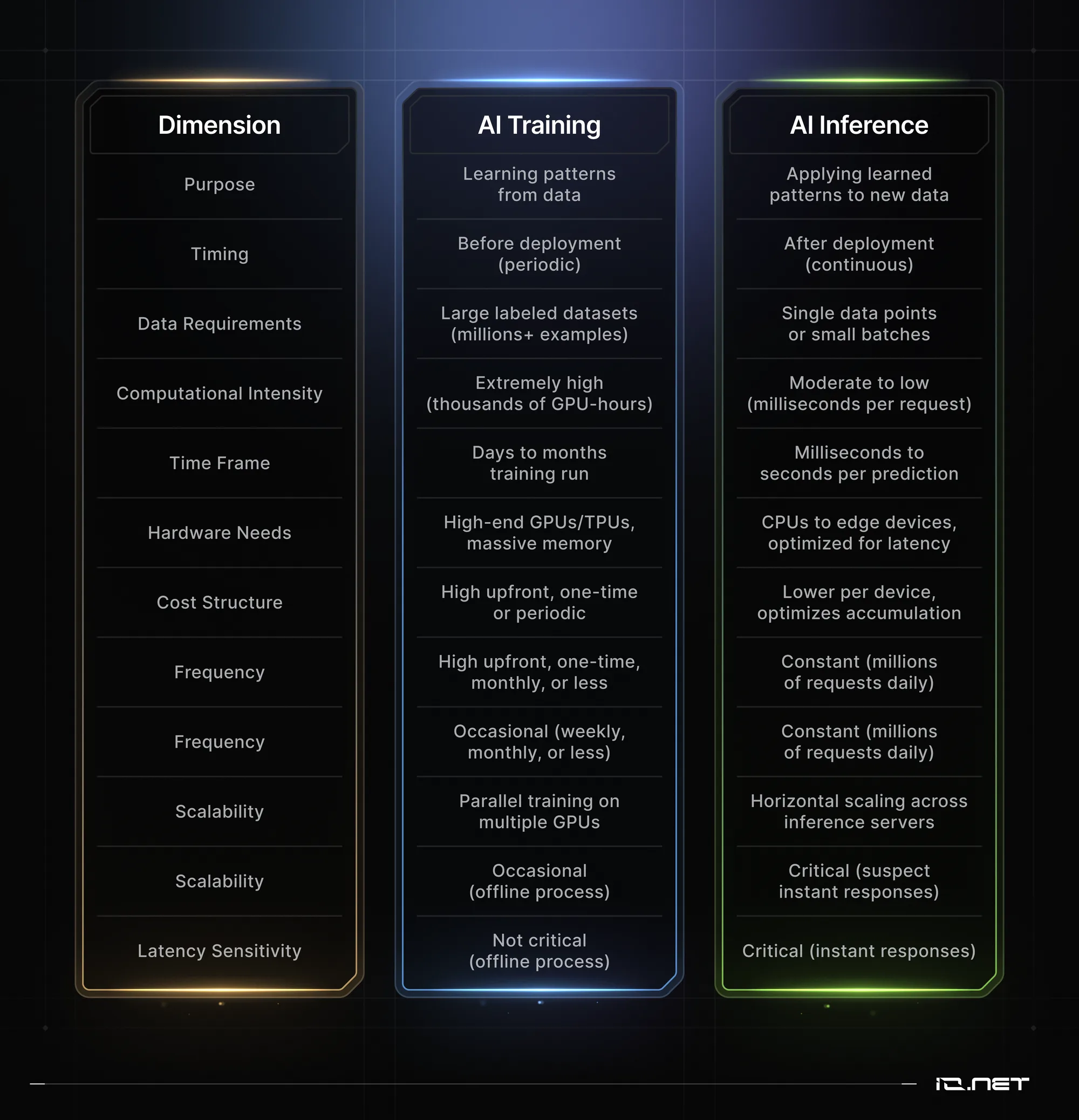
Understanding how training and inference differ across multiple dimensions helps you make better decisions about resource allocation and infrastructure planning.
Purpose
Training creates intelligence, inference deploys it. Training is about the process of discovery and finding patterns that generalize to new situations. Inference is about application and using those discovered patterns efficiently.
Computational intensity
Training requires orders of magnitude more computation than inference. Training GPT-3, for instance, required approximately 3,640 petaflop-days of computing power; equivalent to the computational work of a modern high-end smartphone running non-stop for 100,000 years. A single inference request uses a tiny fraction of that, enough to respond in under a second on consumer hardware.
Data requirements
Training needs comprehensive datasets covering a comprehensive range of scenarios the model will encounter. Inference processes one new example at a time, or in small batches, making predictions without accessing the original training data.
Cost implications
Training incurs higher upfront costs, while inference costs accumulate continuously. Successful AI applications serving millions of users generate inference costs that often exceed training costs over the product's lifecycle.
Model modification
Training constantly updates model parameters to improve accuracy. Inference keeps parameters frozen and simply runs calculations through the network to create outputs. This is why you can run inference on less powerful hardware, as there's no back-propagation or gradient computation.
Stop waiting for GPU access
Instant deployment across 5,000+ GPUs in 138 countries. No contracts, no lock-in, no DevOps overhead.
Hardware Requirements: Training vs Inference
The computational demands of training and inference require fundamentally different hardware strategies.
Training Hardware Needs
Training demands the most powerful computing infrastructure available. That infra is as follows:
High-end GPUs or TPUs
Modern training relies on NVIDIA A100 or H100 GPUs, Google TPUs, or specialized AI accelerators; chips that excel at parallel matrix operations required for backpropagation. Training LLMs often requires clusters of hundreds or thousands of GPUs, all working in parallel.
Massive memory capacity
Training keeps entire batches of data, model parameters, gradients, and optimizer states in memory simultaneously. Large models require hundreds of gigabytes of GPU memory, often requiring memory-efficient techniques like gradient checkpointing or model parallelism.
High-bandwidth storage
Training continuously reads massive datasets from storage. Fast NVMe SSDs and high-throughput network storage prevent data loading from becoming a bottleneck.
High-performance networking
When training spans multiple GPUs or machines, high-bandwidth, low-latency interconnects (like NVIDIA NVLink or InfiniBand) are essential for synchronizing parameters across devices.
Inference Hardware Needs
On the flip side, inference offers far more flexibility in hardware choices. Here are some examples:
Cloud to edge spectrum
Inference can run on powerful cloud servers, modest CPUs, mobile processors, or specialized edge devices. The choice depends on factors like latency requirements, cost constraints, and where data originates.
Latency optimization
Real-time inference prioritizes low-latency hardware. This might mean keeping models on GPUs for complex tasks or using optimized CPUs with efficient libraries for simpler models.
Cost-effective alternatives
Since inference happens continuously, cost per inference matters enormously. Many applications use cheaper CPU-based inference, especially after model optimization techniques reduce computational requirements.
Specialized inference accelerators
Devices like Google Coral, NVIDIA Jetson, or Apple Neural Engine provide efficient inference for specific deployment scenarios like edge computing, mobile applications, or embedded systems.
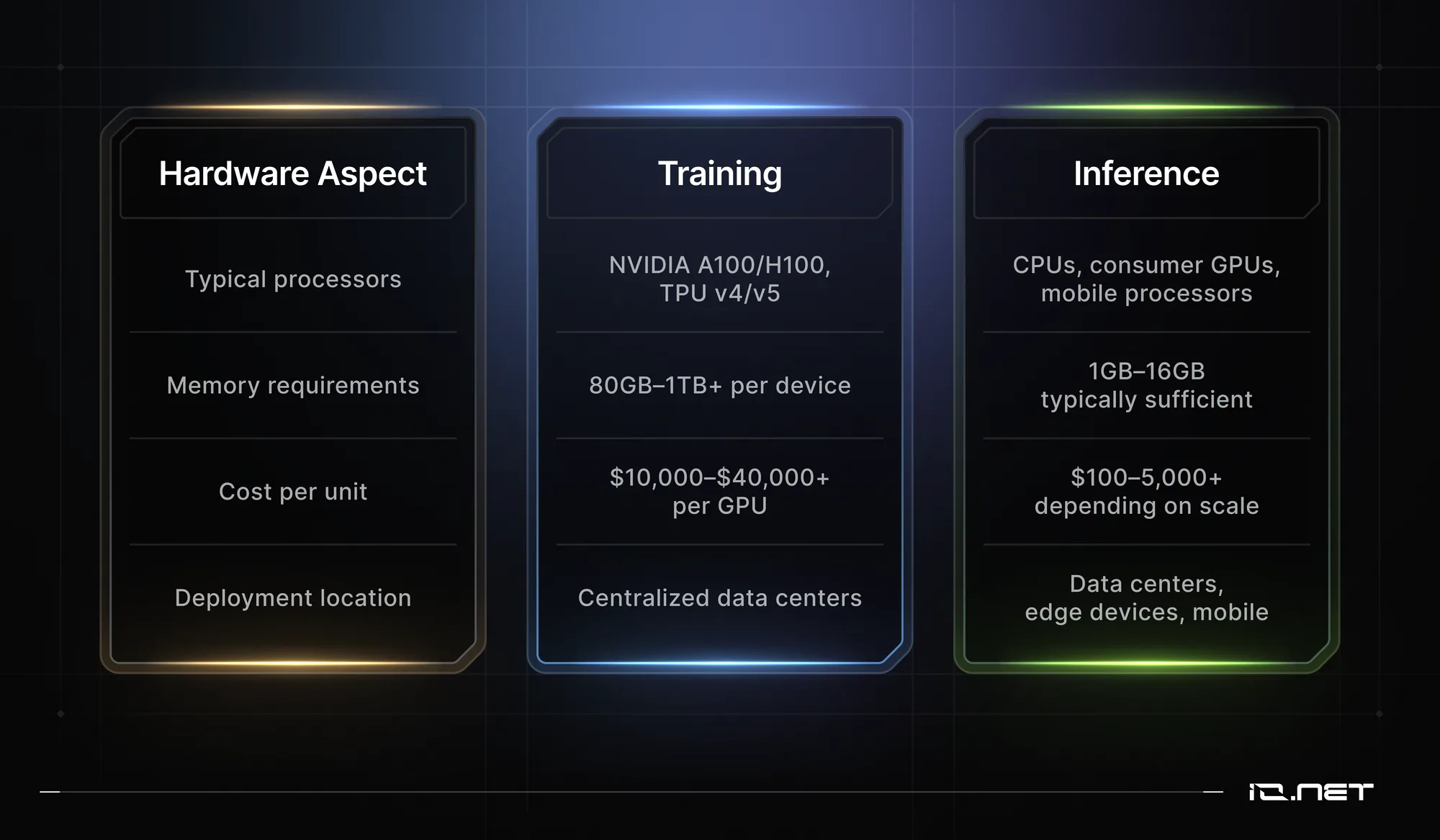
The beauty of inference is that models trained on expensive hardware can be optimized and deployed on much cheaper infrastructure through techniques like quantization, pruning, and knowledge distillation.
Cost Analysis: The Economics of Training vs Inference
A good grasp of AI economics means looking beyond upfront training costs to the ongoing expenses of serving production models.
Upfront Training Costs
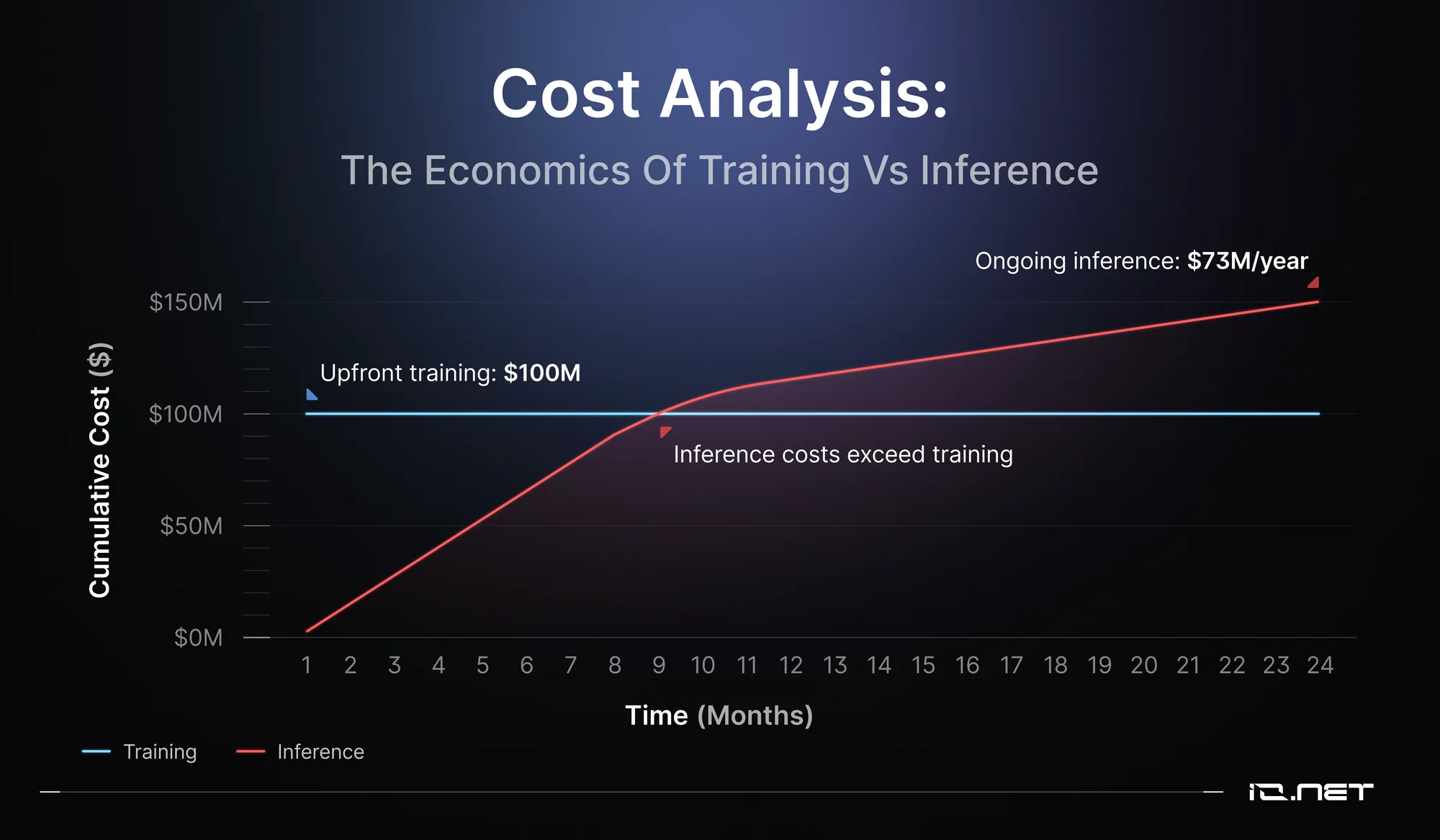
Training costs can be staggering for large models. OpenAI reportedly spent over $100 million training GPT-4, while the training of other cutting-edge models can reach hundreds of millions when accounting for costs like experimentation, failed runs, and infrastructure build-outs.
For typical enterprise AI projects, training costs include GPU rental ($2-$10+ per GPU-hour on cloud platforms), data acquisition and labeling, engineering time, and experimental iterations. A moderately complex model might cost $10,000-$100,000 to train, while more sophisticated models can easily exceed millions of dollars in outlays.
Run inference at 90% lower cost
One API for 25+ open-source models. OpenAI-compatible endpoints. Built-in RAG. No rate limits.
Ongoing Inference Costs
The surprising reality is that for the successful AI applications that reach end users, be they individuals or enterprise customers, inference costs will often dwarf training costs over time. That’s because pennies per request add up quickly when you’re serving millions or even billions of predictions for prompts.
Consider a LLMserving 100 million requests daily. At $0.002 per request (a conservative estimate for API-based inference), that's $200,000 daily or $73 million annually. Those figures far exceed most model training budgets. And this doesn’t even account for variations in cloud inference pricing by provider and model complexity:
- Simple CPU-based inference: $0.0001-$0.001 per request
- GPU-accelerated inference: $0.001-$0.01 per request
- Large language model APIs: $0.002-$0.06 per 1K tokens
Why Inference Costs Can Exceed Training
Several factors drive inference costs higher than training over time:
- Frequency disparity. You train once but serve potentially billions of inferences. Even tiny per-request costs accumulate into massive expenses.
- Always-on infrastructure. Inference servers must run continuously to provide responsive service, while training infrastructure can be shut down between runs.
- Latency requirements. Real-time inferences often can't maximize hardware utilization. You maintain excess capacity to handle peak loads and ensure fast response times.
- Geographic distribution. Serving global users requires deploying inference infrastructure across multiple regions, multiplying costs.
Cost Optimization Strategies
That being said, smart organizations can reduce inference costs through a number of strategies, which include:
- Model optimization. Quantization, pruning, and distillation can reduce model size but also inference costs by 50-90% with minimal accuracy loss.
- Batch processing. When real-time isn't required, batch inference maximizes hardware utilization.
- Caching. Storing responses to common queries eliminates redundant inference costs over time.
- Right-sized hardware. Using CPUs or smaller GPUs for simpler models instead of over-provisioning.
- Reserved capacity. Committing to cloud infrastructure long-term (1-3 years) can reduce costs 40-70% compared to on-demand pricing.
The total cost of ownership requires balancing upfront training investment against ongoing inference expenses, factoring in your expected request volume, latency requirements, and model complexity.
Real-World Examples: Training and Inference in Action
Some concrete examples would be helpful in illustrating exactly how training and inference work together to deliver AI applications.
Training Examples
Large language models
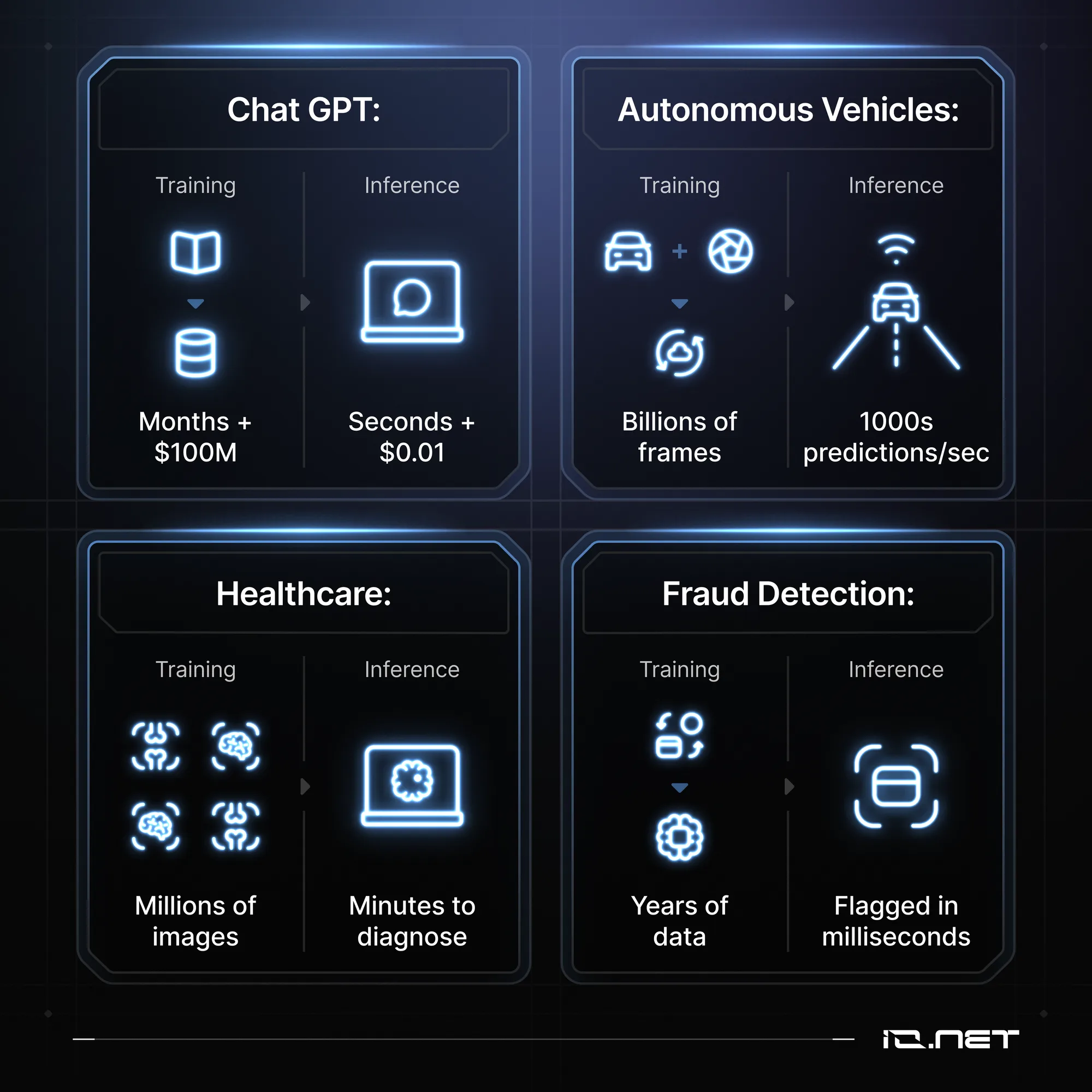
OpenAI trained GPT-4 on hundreds of billions of words from books, websites, and other sources over many months, using thousands of GPUs. The costs exceeded $100 million and involved sophisticated techniques to handle the model's 1.7+ trillion parameters. The high costs, however, produced a model that grasps words and generates human-like text accordingly.
Computer vision systems
Tesla trains its Full Self-Driving models on billions of video frames collected from its vehicle fleet, identifying patterns in how humans drive, recognize obstacles and respond to them, and navigate roads of various types (highways, one-way streets, roundabouts with multiple exit points, etc). Training runs continuously as new data accumulates, requiring massive GPU clusters and specialized data pipelines to handle the constant flow of inputs.
Recommendation engines
Netflix trains its recommendation models on the viewing histories of its 301.6+ million global subscribers, analyzing what content different user segments enjoy and engage with the most. Training occurs regularly, on a daily or weekly basis, capturing changing preferences and incorporating new content and recommendations into the system.
Inference Examples
ChatGPT Conversations
Every prompt you give ChatGPT triggers an inference, which processes your text and generates a response in seconds. While the costs of initial training were considerable, each inference costs OpenAI a fraction of a penny. But again,with millions of users prompting models multiple times a day, costs add up to tens of millions of dollars monthly.
Autonomous Vehicles
Self-driving cars run continuous inference on camera, radar, and LIDAR data, making thousands of predictions per second in response to input data about road conditions, obstacles, and safe paths. While these models were trained in data centers, their inferences happen on specialized hardware inside each vehicle, enabling data processing with minimal latency, a necessity with automobiles that require split-second and safe decisions.
Fraud Detection
Banks and payment processors run inferences on every transaction, using trained models to assign fraud risk scores in milliseconds. A model trained on historical fraud patterns, for instance, analyzes transaction amount, location, timing, and behavior patterns to flag suspicious activity before the transaction completes.
Healthcare
Medical imaging AI systems analyze X-rays, CT scans, and MRIs to detect tumors, fractures, and other abnormalities. These models are trained on millions of labeled medical images from hospitals worldwide, learning to identify patterns that indicate disease. During inference, a radiologist uploads a new scan, and the model highlights potential areas of concern within minutes, helping physicians make faster, more accurate diagnoses while reducing the workload on overstretched medical staff.
Industry-Specific Applications
Healthcare
Radiology AI models are trained on millions of labeled medical images to detect tumors, fractures, disease markers, and other medical conditions. In hospitals, these models run inferences on new patient scans, providing diagnostic assistance in minutes rather than the hours human review might require. (*Note: Medical AI model outputs are reviewed and approved by humans-in-the-loop like nurses, doctors, researchers, etc.)
Financial services
Trading firms train models on decades of market data to identify patterns predicting price movements. These models run inference continuously, analyzing real-time market data and, when favorable opportunities arise, execute trades in microseconds.
Retail
E-commerce platforms train recommendation models on customer data like purchase history, browsing behavior, and product attributes. When you visit the site, an AI model inference generates personalized suggestions based on your profile and live session, updating recommendations in real-time as you browse.
The AI Lifecycle: From Training to Production
Understanding how training and inference fit into the broader AI lifecycle helps you plan resources and workflows effectively.
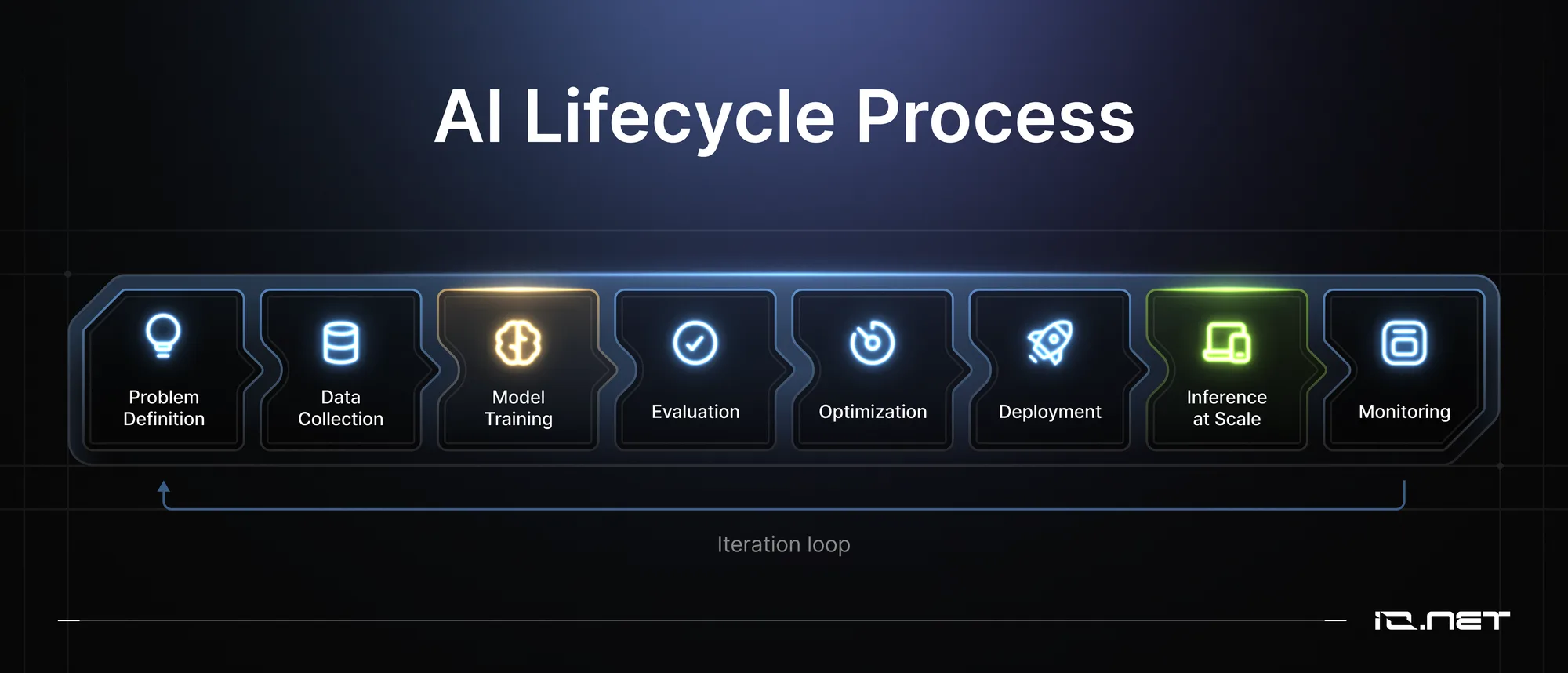
Model Development Workflow
The journey from concept to production follows these stages:
- Problem definition. Identifying what you want the AI to accomplish and gathering requirements.
- Data collection. Assembling training datasets, often the most time-consuming phase of the lifecycle..
- Model training. The most compute-intensive phase where AI models analyze and learn from data.
- Evaluation and validation. Testing model performance on held-out data to ensure it generalizes well.
- Model optimization. Compressing and optimizing the trained model for efficient inference.
- Deployment. Moving the model into production infrastructure where it can serve real requests.
- Inference at scale. The operational phase where the model generates business value for the end user.
- Monitoring and maintenance. Tracking model performance and detecting degradation over time.
Continuous vs One-Time Training
It’s also worth noting that different applications require different training cadences. Most applications fall under one of the following frameworks:
- One-time training. Some models are trained once and used indefinitely. A model classifying medical images might remain effective for years if disease presentation doesn't change significantly.
- Periodic retraining. Many applications retrain weekly or monthly as new data arrives. E-commerce recommendations retrain to incorporate new products and changing user preferences.
- Continuous training. Dynamic environments require ongoing training. Fraud detection models continuously learn from new fraud patterns, and advertising models constantly optimize based on campaign performance.
Ship AI features faster with VOLT Intelligence
Switch from OpenAI in one line of code. Access Llama, Mixtral, Qwen, and more through a single endpoint.
Model Updates and Retraining
Models degrade over time as the world changes. This is a phenomenon known as model drift. User behavior shifts, new products launch, and adversaries adapt to detection systems.
Effective AI operations that combat model drift include:
- Performance monitoring. Tracking accuracy, latency, and business metrics to detect degradation.
- Automated retraining pipelines. Systems that automatically trigger retraining when performance drops or new data becomes available.
- A/B testing. Deploying new model versions to subsets of traffic to validate improvements before full rollout.
- Rollback capability. Maintaining previous model versions to quickly revert if new versions perform poorly.
MLOps Considerations
Production AI also requires operational discipline. Here are some best practices to implement within your MLOps for optimal training efficiency and outcomes:
- Version control. Tracking which model version, training data, and code produced each model.
- Infrastructure as code. Automating deployment and scaling of training and inference infrastructure.
- Feature stores. Centralizing feature engineering logic used consistently in training and inference.
- Model registries. Cataloging trained models with metadata about performance, training conditions, and deployment history.
The goal here is treating AI models like software, which means using the same levels of rigorous testing, deployment processes, and operational monitoring.
Optimization Strategies for Training and Inference
Maximizing efficiency in both training and inference phases reduces costs and improves performance. Following some of the strategies below across both phases will help you get the most out of your model.
Training Optimization
Transfer learning
Instead of training from scratch, start with a pre-trained model and fine-tune it on your specific data. This can reduce training time by as much as 90% and required data by 95%. A custom image classifier, for instance, might start with a model pre-trained on ImageNet and later fine-tuned on your specific product images.
Data efficiency techniques
Not all training examples are equally valuable. Active learning identifies which examples would most improve the model, reducing training data requirements. Data augmentation artificially expands datasets by creating variations (rotating images, paraphrasing text), improving model robustness without collecting more data.
Distributed training
Splitting training across multiple GPUs or machines dramatically accelerates the process. Data parallelism processes different batches on each GPU, while model parallelism splits large models across devices when they don't fit in single-GPU memory.
Mixed precision training
Using lower-precision numbers (16-bit instead of 32-bit) reduces memory requirements and speeds computation with minimal accuracy impact, enabling larger models or batch sizes on the same hardware.
Inference Optimization
Model quantization
Converting model parameters from 32-bit to 8-bit or even 4-bit integers can reduce model size by 75% and speed inference 2-4x with negligible accuracy loss. This is especially valuable for edge deployment where memory and power are constrained.
Model pruning
Removing unnecessary neural network connections that contribute little to predictions can shrink models by 50-90%. Pruned models run faster and fit on less powerful hardware while maintaining accuracy.
Knowledge distillation
Training a smaller "student" model to mimic a larger "teacher" model's behavior. The student model might be 10x smaller but retain 95%+ of the teacher's accuracy, perfect for mobile or edge deployment.
Edge deployment
Running inference on user devices or edge servers instead of centralized clouds reduces latency (no network round-trip), cuts bandwidth costs, and improves privacy. All while the data stays completely local.
Response caching
Storing responses to common queries eliminates redundant computation. If 20% of queries repeat frequently, caching can reduce inference costs by 20% immediately.
Dynamic batching
Grouping multiple inference requests together improves GPU utilization, reducing cost per request by 2-10x for workloads where slight latency increases are acceptable.
Train foundation models without the foundation costs
Distributed GPU clusters with Ray-native orchestration. Same hardware as OpenAI used for GPT-3, at 70% less.
Choosing the Right Infrastructure for Your AI Project
Deciding how and when to allocate resources between training and inference depends on your specific use case.
When to Prioritize Training Resources
Invest heavily in training infrastructure during the following scenarios:
- Frequent experimentation. Focus on training infrastructure when you're actively developing models that require fast iteration cycles. Slow training extends development timelines and delays time-to-market.
- Large-scale models. Training foundation models, large language models, or complex computer vision systems requires cutting-edge hardware. The quality difference between adequate and excellent training infrastructure directly impacts model performance.
- Data-intensive applications. With hundreds of millions of training examples, training time becomes a bottleneck. Powerful infrastructure prevents data from sitting unused while waiting for training to complete.
- Competitive advantage through model quality. When model accuracy directly drives business value, investing in training infrastructure to achieve marginally better models pays dividends.
When to Prioritize Inference Resources
You’ll know to invest heavily in inference infrastructure when some of these conditions arise:
- High request volumes. Serving millions or billions of daily predictions means inference dominates your costs. Optimizing inference efficiency delivers immediate ROI.
- Latency-critical applications. When speed matters. Real-time applications like autonomous vehicles, fraud detection, or conversational AI require fast, reliable inference..
- Geographic distribution. Global applications need inference infrastructure close to users worldwide. Training can happen centrally, but inference must be distributed.
- Mature model. Once your model architecture stabilizes, training frequency decreases while inference volume grows. The cost balance shifts heavily toward inference.
Hybrid Approaches
Most successful AI operations balance both training and inference. Here are some effective hybrid models you should consider adopting, depending on your circumstances:
- Cloud training + edge inference. Train powerful models in the cloud on beefy GPUs, then deploy optimized versions to edge devices. This is the best of both worlds, blending training flexibility with inference efficiency.
- Reserved training capacity + elastic inference. Maintain dedicated training infrastructure for ongoing model development while using auto-scaling cloud inference to handle variable load.
- Specialized hardware for each phase. Use high-memory training GPUs (A100, H100) for model development and cost-optimized inference GPUs (T4, L4) or CPUs for serving predictions.
Cloud vs On-Premises Decision Framework
The choice between cloud and on-premises infrastructure depends on your workload characteristics, budget model, and operational requirements. What works well for one company's model training might not work well for you; and over time, your own circumstances and needs will probably evolve.
Choose cloud when:
- Getting started with AI and wanting to limit or avoid capital expenses
- Request volume varies significantly (seasonality, growth)
- You need geographic distribution across regions
- Access to latest hardware matters for competitive advantage
Choose on-premises when:
- Sustained high volumes make cloud costs prohibitive
- Data sensitivity or regulatory requirements limit cloud usage
- Predictable workloads enable accurate capacity planning
- You have existing data center infrastructure to leverage
Hybrid cloud approaches let you train in the cloud but serve high-volume inference on-premises, or turn to the cloud for spillover capacity during peak loads.
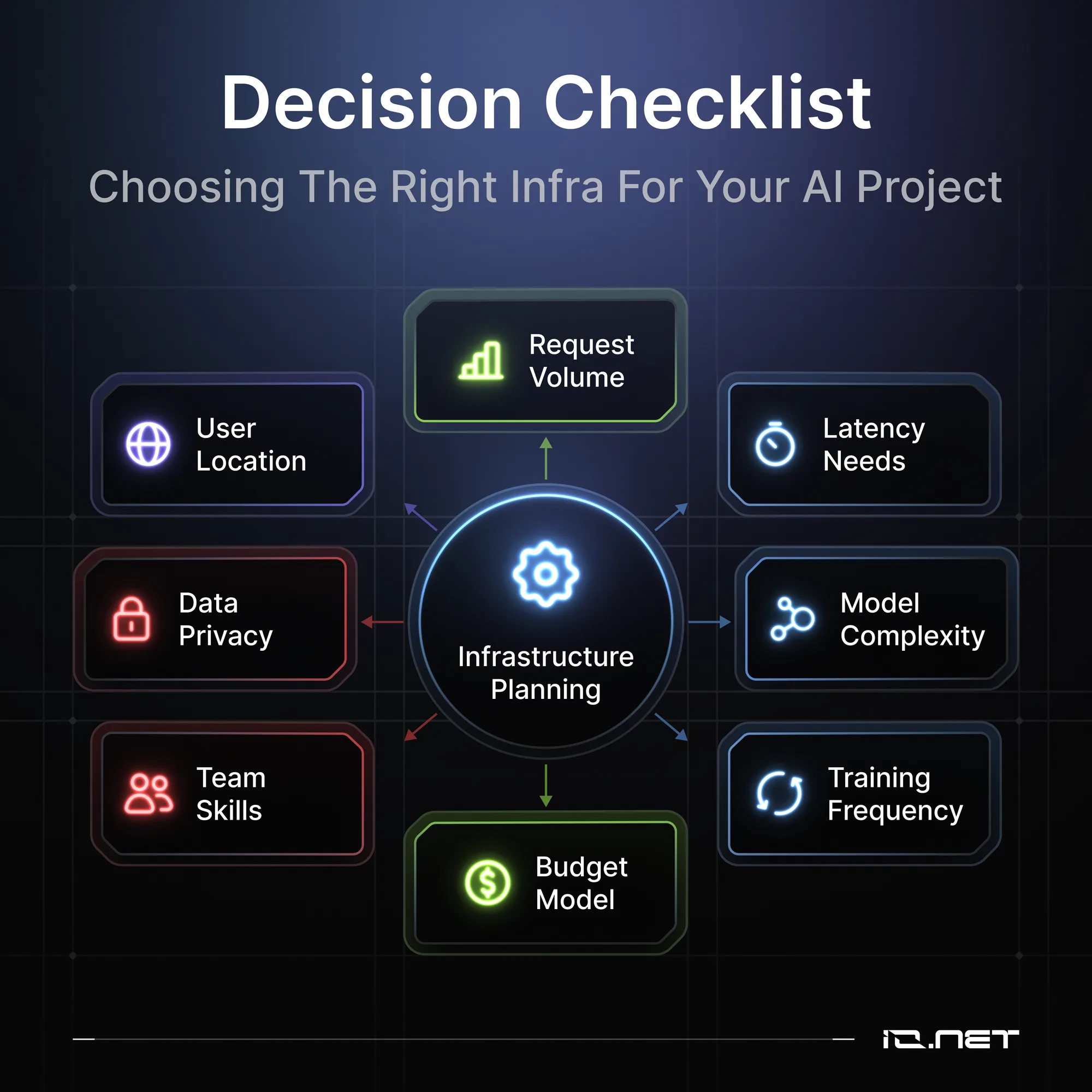
Decision Checklist
When planning your model’s infrastructure, here are a few things you need to consider:
- Expected daily/monthly inference request volume
- Latency requirements (real-time vs batch acceptable)
- Model size and complexity
- Training frequency (continuous vs periodic)
- Budget constraints (capital vs operational expenses)
- Team expertise with different platforms
- Data privacy and regulatory requirements
- Geographic distribution of users
The right infrastructure strategy aligns technical requirements with business priorities and budget realities.
Future Trends in AI Training and Inference
The AI landscape is evolving rapidly, with several trends reshaping how we think about training and inference. But today’s model training trends might not apply to all of tomorrow’s models, so it’s smart to create a framework for how to think about the ways training and inference will develop over time.
Edge AI and Distributed Inference
The future of inference is moving to the edge, like processing data on user devices, IoT sensors, and edge servers rather than centralized clouds. To take a few examples, Apple's Neural Engine, Google's Tensor chips, and Qualcomm's AI accelerators bring sophisticated inference capabilities to smartphones. This trend delivers lower latency, enhanced privacy, and reduced bandwidth costs.
Edge inference also requires highly optimized models. Techniques like on-device training adaptation enables models to personalize inferences for individual users without uploading and permanently storing data to the cloud, offering increased performance without sacrificing user privacy.
Smaller, More Efficient Models
The industry is moving beyond a "bigger is better” mentality toward a greater focus on efficiency instead of just scalability While GPT-4 and similar models demonstrate the power of scale, other models like Microsoft's Phi-3 and Google's Gemini Nano prove that smaller, carefully trained models can match larger predecessors on many tasks while requiring orders of magnitude less compute.
This efficiency revolution democratizes AI, making sophisticated capabilities accessible on modest hardware and reducing the environmental impact of AI inference at scale.
The Growing Inference Market
As AI deployment matures, inference is becoming the larger market opportunity. Gartner predicts that by 2025, 80% of AI infrastructure spending will be on inference rather than training, a shift that is already driving innovation in inference-specific hardware, software optimization, and serving platforms.
Specialized inference chips from companies like Cerebras, Groq, and SambaNova promise 10-100x efficiency improvements over general-purpose GPUs for specific workloads.
Regulatory and Compliance Considerations
Emerging AI regulations like the EU AI Act introduce new requirements for model transparency, auditability, and fairness. These regulations impact both training (documenting data sources, bias testing) and inference (explaining predictions, monitoring for discriminatory outcomes).
As a result, organizations must build infrastructure that supports compliance requirements. Things like model lineage tracking, prediction explainability, and audit trails of inference decisions are becoming more critical. The convergence of these trends suggests a future where AI is more efficient, more distributed, and more accessible while maintaining rigorous operational standards.
Conclusion
AI training and inference represent two fundamentally different phases of the AI lifecycle, each with distinct computational requirements, costs, and optimization strategies. Training is the intensive learning phase that’s expensive, time-consuming, and performed periodically. It’s the crucial stage of AI development where models extract patterns from massive datasets, laying the foundation for inference that delivers all of the powerful AI user experiences we now enjoy.
Inference is the application phase that’s continuous, cost-sensitive, and performance-critical. It’s where trained models deliver real value for individual and enterprise users by making predictions on new data.
Key insights:
- Training requires powerful hardware and substantial upfront investment, but happens infrequently.
- Inference uses less powerful hardware per request, but accumulates massive costs through volume and over time.
- For successful AI applications, lifetime inference costs often exceed training costs depending upon the model and scenario.
- Different optimization strategies apply to each phase, like distributed training and transfer learning for training, quantization, pruning, and edge deployment for inference.
- Infrastructure decisions should balance training flexibility with inference efficiency based on your application's specific requirements.
Whether you're building your first AI application or optimizing an existing deployment, understanding the training-inference distinction helps you make informed decisions that matter to your project the most, like resource allocation, infrastructure investment, and optimization priorities.
Ready to optimize your AI infrastructure?
Start by measuring your current training and inference costs, identifying bottlenecks, and applying targeted optimizations to the phase consuming more resources. The difference between a struggling AI project and a profitable one often comes down to mastering these fundamentals.
Train foundation models without the foundation costs
Distributed GPU clusters with Ray-native orchestration. Same hardware as OpenAI used for GPT-3, at 70% less.