New Research Shows Consumer GPUs Can Cut AI Inference Costs by 75%
Try VOLT Intelligence
Get StartedTry VOLT Cloud
Deploy GPU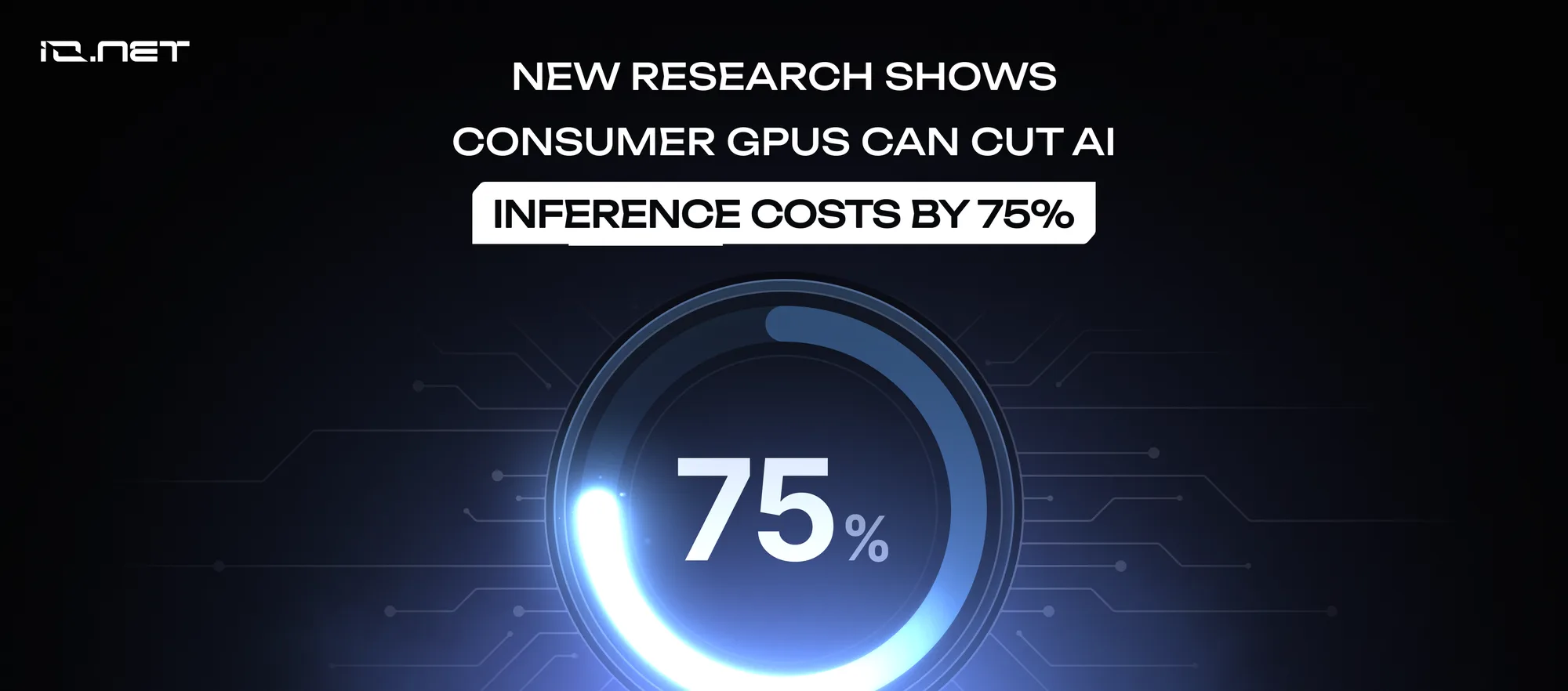
A new peer-reviewed study from VOLT confirms what many developers have suspected: consumer GPUs like the RTX 4090 can deliver serious compute performance for LLM inference at a fraction of enterprise costs.
The paper, Idle Consumer GPUs as a Complement to Enterprise Hardware for LLM Inference, was accepted by the 6th International Artificial Intelligence and Blockchain Conference (AIBC 2025). It provides the first open benchmarks of heterogeneous GPU clusters deployed on VOLT's decentralized infrastructure.
The Core Findings
The numbers tell a compelling story. RTX 4090 clusters can achieve 62-78% of H100 throughput at roughly half the operational cost. For batch processing and latency-tolerant workloads, token costs drop by up to 75%.
While H100s remain 3.1× more energy-efficient per token, the study shows that leveraging idle consumer GPUs can actually reduce embodied carbon emissions by extending hardware lifetimes and tapping into renewable-rich power grids.
What This Means for Developers
The research points to a practical middle path. Instead of choosing between enterprise or consumer GPUs, developers can optimize for specific use cases.
Use H100s for real-time applications that demand sub-55ms P99 time-to-first-token latency. Deploy consumer GPU clusters for development environments, batch processing, overflow capacity, and any workload that can tolerate 200-500ms tail latencies (think research environments, streaming chat, embedding generation, and evaluation sweeps).
Aline Almeida, Head of Research at IOG Foundation and lead author, explains:
The Sweet Spot Configuration
A 4× RTX 4090 setup hits the best cost-performance ratio, delivering $0.111-0.149 per million tokens while maintaining 62-78% of H100 throughput. For teams running development cycles, batch jobs, or non-latency-critical inference, this configuration makes enterprise-level compute accessible.
Why This Matters
As Gaurav Sharma, CEO of VOLT, notes: "This peer-reviewed analysis validates the core thesis behind VOLT: that the future of compute will be distributed, heterogeneous, and accessible. By harnessing both datacenter-grade and consumer hardware, we can democratize access to advanced AI infrastructure while making it more sustainable."
The full research paper and benchmarks are available in the GitHub repository.