Decentralized Computing in 2025: Architecture, Costs, and Migration Guide
Try VOLT Intelligence
Get StartedTry VOLT Cloud
Deploy GPUTable of Contents
- What is Decentralized Computing?
- How Decentralized Computing Works
- Best Practices for Decentralized Computing
- Your Next Steps
- Frequently Asked Questions
- How does decentralized computing actually work?
- What are the cost and latency trade-offs versus AWS?
- Which protocols are mature enough for enterprise applications?
- How do I handle compliance and GDPR?
- What does migration from Kubernetes look like?
Your latest AWS bill spiked again during the most recent traffic surge, but most of your workload is still pinned to a single region. This kind of uptick in costs isn’t unfamiliar to AI startups. Luckily for you, decentralized computing is moving out of itsniche in crypto and into real production-ready AI systems, helping teams cut infrastructure costs without sacrificing uptime.
This guide breaks down how decentralized compute actually works, why it’s cheaper, and how to start migrating your startup’s AI models in a way that won’t disrupt your stack and wreak havoc on your product, go-to-market strategy, and use acquisition plans.
What is Decentralized Computing?
Decentralized computing is essentially the exact opposite of the current centralized cloud compute model. Rather than relying on giant data centers, decentralized compute spreads processing, storage, and applications across thousands of independent nodes. Think of it like a network of local markets instead of a giant Walmart distribution center, giving people a more distributed access to the goods they need need. Similarly, in a distributed compute network, the computing load gets spread across many nodes offering clusters of CPUs and GPUs, or hybrids of the two.
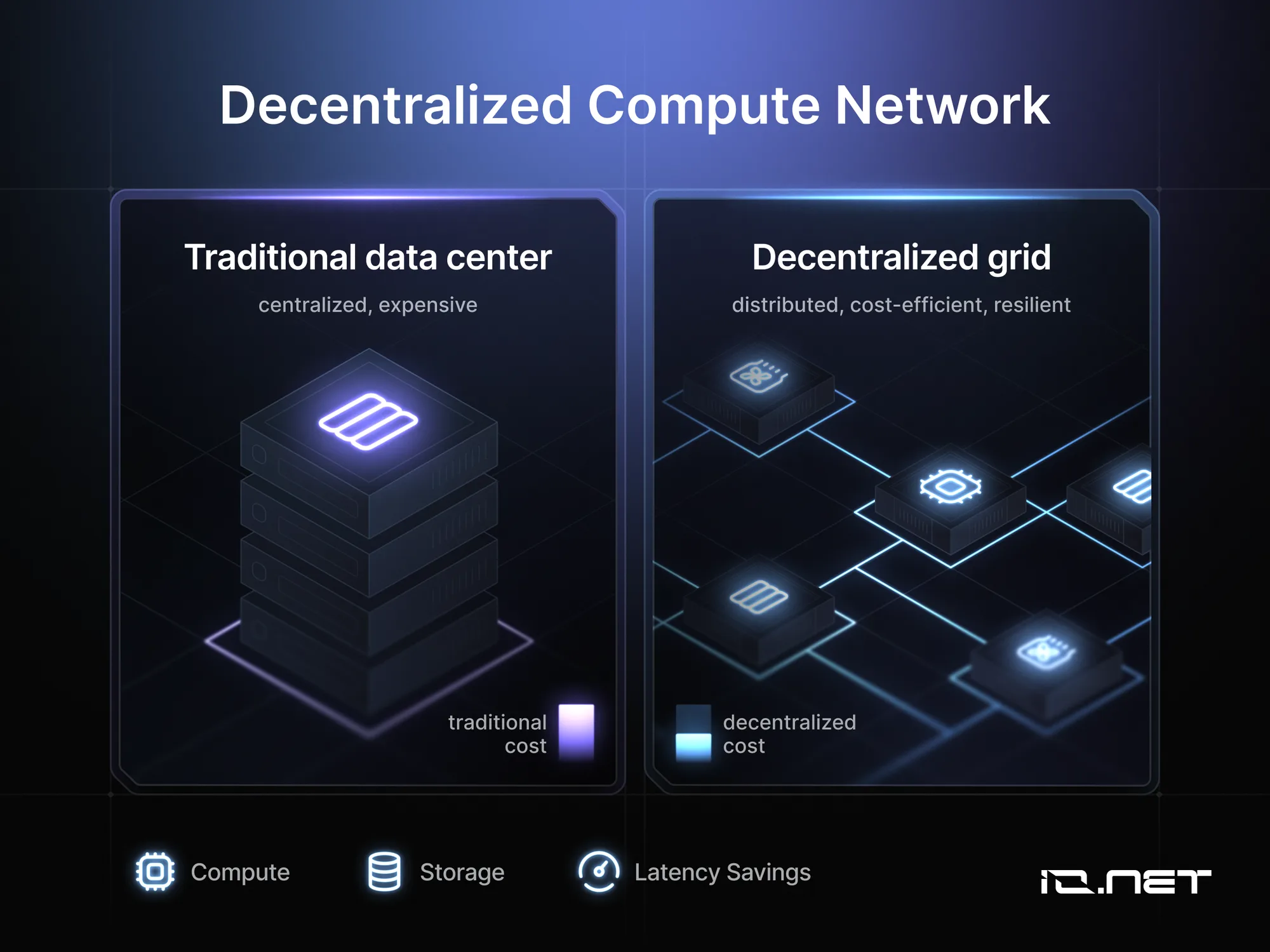
This decentralized approach powers everything from blockchain networks to decentralized cloud computing platforms like Filecoin and Storj, where users rent out unused hard drive space or processing power. By spreading resources across the network, decentralized cloud computing creates a more resilient, private, and cost-effective alternative to traditional cloud services.
After proving its utility and cost-effectiveness in the above scenarios, decentralized compute is rapidly moving into the AI startup space, where demand is high. With decentralized compute now a real market alternative, lean startup teams have the option to pursue the compute setups that give them the most flexibility and cost savings.
300K+ GPUs ready when you are
Global decentralized network across 138 countries. Scale training and inference workloads without centralized bottlenecks.
How Decentralized Computing Works
To better understand how decentralized computing actually works, let’s explore by way of different analogy. Think of decentralized computing as a global Airbnb for processing power: thousands of nodes rent out spare CPU/GPU cycles as an alternative to just one AWS cloud data center.
A mechanism called “consensus”, in which nodes agree that the network’s state or data set is correct (and secure), drives this decentralized compute. Byzantine-fault-tolerant algorithms like Tendermint let systems agree even if a third of nodes are faulty, deciding which run your Docker container. Behind the scenes, a distributed scheduler broadcasts your job's requirements across the mesh, including RAM, GPU, and latency constraints. Within 200 to 600 milliseconds, a quorum selects the node that sits closest to your data.
As AI companies leverage decentralized CPU and GPU clusters to train and run their models, existing business operations are evolving while entirely new business models are also coming into existence. In particular, the integration of AI agents and decentralized computing is creating new opportunities for autonomous workload management across these networks.
Best Practices for Decentralized Computing
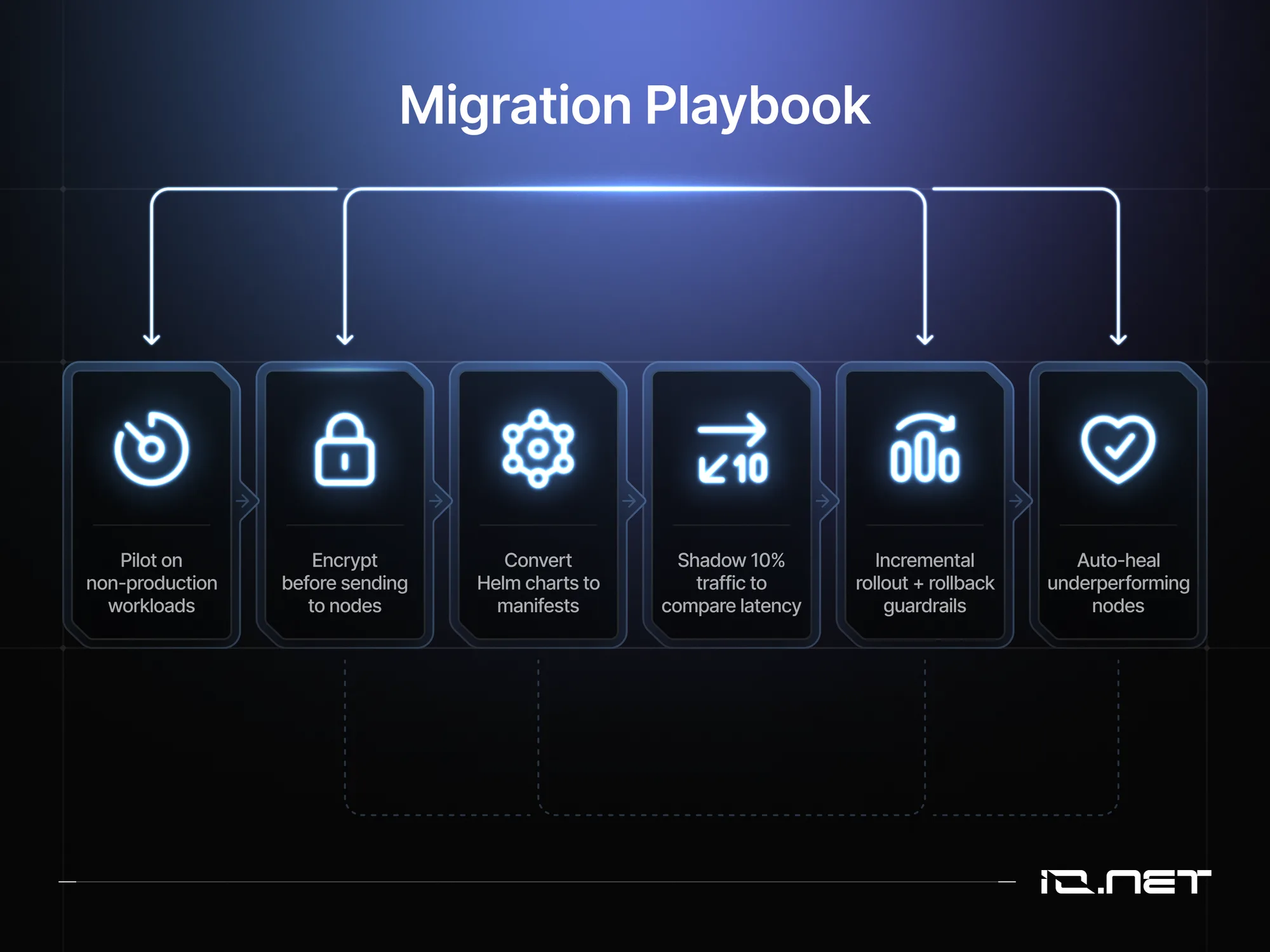
Start small before migrating mission-critical workloads. Multiple companies have achieved substantial cost reductions by piloting decentralized cloud computing for non-sensitive data first, then gradually expanding implementation into production-ready systems.
It’s absolutely crucial to always encrypt data before it leaves your infrastructure. Decentralized storage networks store encrypted fragments across thousands of nodes, making breaches significantly more difficult compared to traditional cloud providers like AWS and Microsoft’s Azure, which both recently experienced breaches.
Understanding the differences between cloud versus edge computing will also help you make informed decisions about workload placement. Edge computing processes data near its source, reducing latency and bandwidth usage while also improving real-time performance. Cloud computing, on the other hand, gives you on-demand access to compute from remote, centralized data centers. Monitor node performance continuously with automated health checks that remove underperforming nodes from your pool.
Decentralized computing is transforming how businesses access high-performance infrastructure, especially for AI and machine learning workloads, and enabling both existing enterprises to evolve their business operations and startups to launch new products and solutions. Platforms like VOLT are leading this shift by offering instant, cost-efficient access to a global pool of GPUs, enabling parallel training, batch inference, and hyperparameter tuning across thousands of nodes.
By leveraging decentralized physical infrastructure (DePIN), teams can deploy scalable compute clusters, monitor real-time job progress, and optimize for latency and cost. Just as importantly, all of this is possible while maintaining end-to-end encryption and regulatory compliance.
For developers and enterprises ready to migrate, VOLT's ecosystem provides comprehensive tools, from cluster management dashboards to secure payment options, making it easier than ever to harness the power of decentralized cloud computing.
Your infrastructure, your way
Bare metal with root access, Ray-native clustering, or managed containers. Full stack control without DevOps overhead.
Your Next Steps
You now have production-grade proof points that showcase exactly how "decentralized computing" isn’t somespeculative concept but instead a budget-ready architecture. Recent comparisons show platforms like Akash Network offering GPU compute at approximately 60 to 70 percent cost savings compared to AWS and Google Cloud.
So, what’s next?
Evaluate the platforms, feed your real traffic patterns into cost calculators, and schedule a sandbox demo with your finance partner. When the numbers align, you'll walk into that budget review with a defensible ROI story. The infrastructure is operational, and the only thing left is to act.
Just remember, decentralized computing today's competitive advantage.
Frequently Asked Questions
How does decentralized computing actually work?
When you submit a job, the protocol's consensus layer records your request. A scheduler runs a continuous auction, matching your workload to providers based on price, hardware specifications, and proximity to your data. Files are split into chunks, encrypted, and cached at edge nodes closest to where the compute will run.
What are the cost and latency trade-offs versus AWS?
Decentralized platforms can offer compute resources at one-third to one-fifth of AWS pricing for similar specifications. The catch is volatility: supply fluctuates, so you must over-provision. Network egress is usually free, but expect 20 to 60 milliseconds of added latency intra-region. For batch workloads like rendering or model training, the savings outweigh the extra latency.
Which protocols are mature enough for enterprise applications?
Akash has audited resource accounting with over 12,000 providers and is used by Fortune 500 companies for scaling AI with decentralized GPU compute. Flux operates with approximately 15,000 nodes and strong support for full-stack applications. Cudos combines Layer-1 blockchain with compute capabilities and has partnered with AMD data centers.
How do I handle compliance and GDPR?
Tag workloads with data classification labels and select providers whose on-chain metadata includes geographic coordinates and certifications like ISO 27001 and SOC-2. Encrypt personal data at source using AES-256 client-side encryption. Use smart-contract policies to auto-vacate data after expiration, and maintain a Record of Processing Activities by exporting on-chain job manifests.
What does migration from Kubernetes look like?
Export your Kubernetes config and mark stateless microservices as tier-1 migration candidates. Swap Helm charts for platform-specific manifests. Create a second namespace on the decentralized network and traffic-shadow to compare latency. Shift 10% of traffic weekly with one-click rollback. Typical timeline: 6–8 weeks for a twelve-service stack with 40–60% run-rate savings.
Cut GPU costs by 90%
Enterprise-grade H100s and A100s at a fraction of hyperscaler pricing. Pay only for what you use.