Try VOLT Intelligence
Get StartedTry VOLT Cloud
Deploy GPUTable of Contents
- Key Results
- Overview
- A Media-Production Studio’s Challenge
- The Strategic Problem
- Why A Media-Production Studio Chose VOLT Intelligence’s AI Infrastructure
- How A Media-Production Studio Integrated VOLT Intelligence’s AI Infra
- The Results: AI Infrastructure That Enabled Business Viability
- Technical Validation of A Media-Production Studio’s Business Model
- Key Performance Insights
- About This Partnership
Key Results
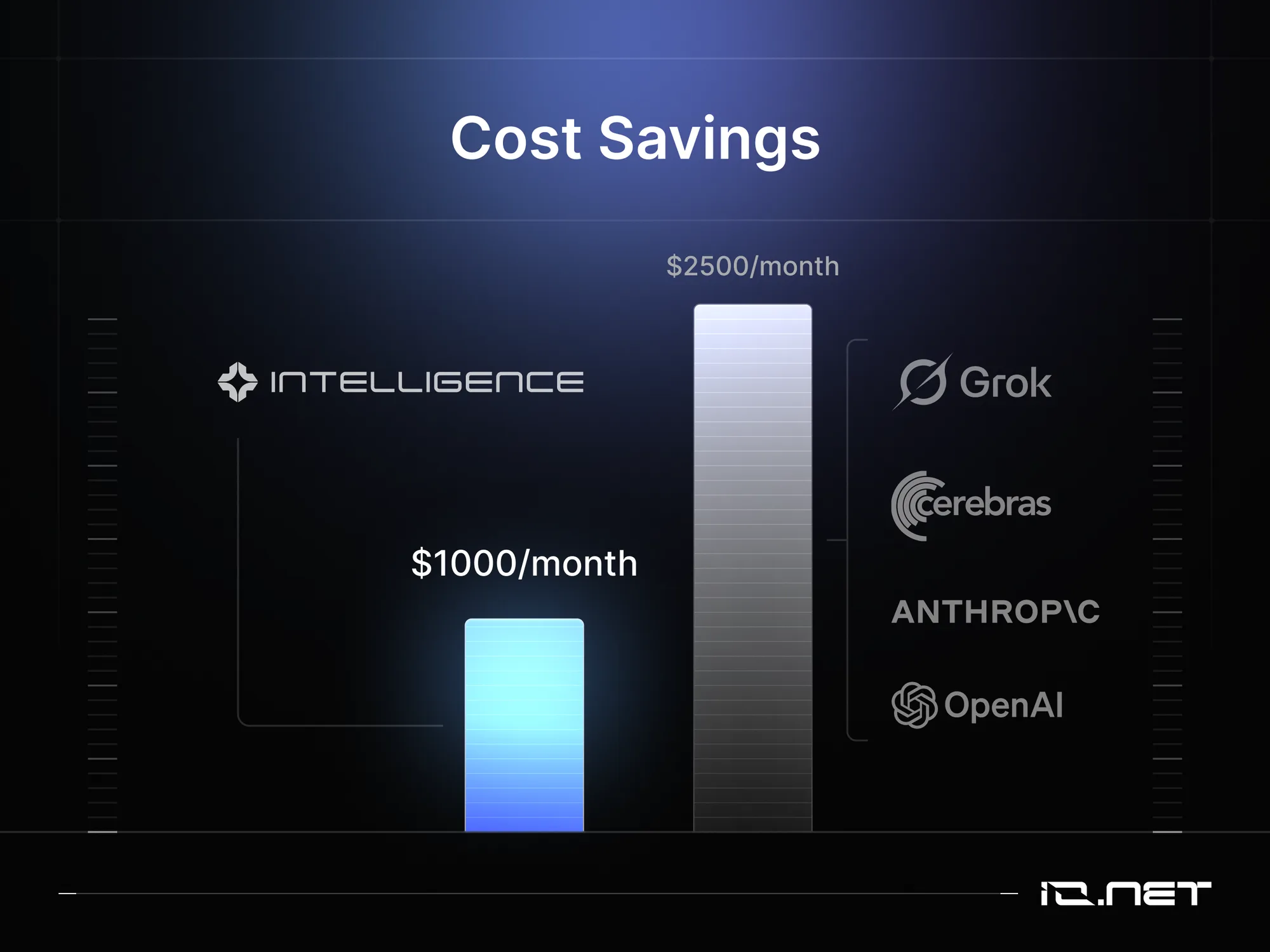
- 60% cost reduction from $2,500/month to $1,000/month per customer compared to a media-production studio’s previous multi-provider setup
- 2-person team operating with 10-person efficiency through meta-coding agents powered by VOLT Intelligence
- 5 revenue-generating customers served simultaneously while building product
- 40-55k tokens processed daily per customer across SQL agents, document schema generation, and LLM report generation
Overview
, a New York-based pre-seed AI infrastructure startup, transformed from the ground up how they build and deploy command centers by leveraging VOLT Intelligence to power their meta-coding agent architecture. Co-founded in September 2024 by the founder (CEO) and the founder (CTO), the 2-person team needed reliable, cost-effective access to multiple AI models to validate their agent-driven environment, specifically designed to build and maintain private command centers tailored to each customer using coding agents.
As a lean team, a media-production studio was constrained out of the gates by both limited provider options and escalating costs across multiple API services (Groq, Cerebras, Anthropic, OpenAI). The team was spending ~$2,500/month on compute per customer while constantly researching, testing, and managing fragmented infrastructure. They needed to prove their agent-first architecture could serve enterprise customers while also maintaining profit margins sustainable for angel-funded growth.
With VOLT Intelligence's unified API and on-demand model access, a media-production studio consolidated their infrastructure, enabling the team to reduce costs by nearly 60% to ~$1,000/month and gain access to critical reasoning models, like K2-Think and DeepSeek-R1, that power their meta coding agents. the founder and Konrad now operate with the efficiency of a 10-person engineering team, serving 5 revenue-generating customers while building their core product.
A Media-Production Studio’s Challenge
After raising angel funding to build their platform for enterprises to control and deploy meta coding agents, the two-person a media-production studio team began working remotely with five deployed customers generating revenue.
The team developed a unique approach to developing command centers where AI agents create, deploy, and maintain custom solutions to collapse the feedback loop between idea and execution. However, they faced one critical challenge: proving their agent architecture could scale profitably on pre-seed budgets.
The Strategic Problem
The media-production studio team learned rather quickly that the traditional compute model of a multi-provider setup just wasn’t sustainable. Constrained to two to three providers, including Groq, Cerebras, Anthropic, and OpenAI, the team was limited to only the models those providers offered. As the founder elaborates, “And then we’d be limited to the pricing of how it's offered through [the providers]."
At $2,500/month in compute costs across multiple providers, a media-production studio faced an unsustainable burn rate. Heavy project deployments cost roughly $300 per pipeline when processing 6,000 contracts or 48,000 tweets, while coding agents consumed over $1,000/month. Each batch of LLM applications required 20-40K tokens per run.
Without cost-efficient, multi-model infrastructure, the company realized they would need to either hire a traditional 10-person engineering team (destroying their margin structure), limit their product capabilities to fewer models (destroying competitive advantage), or reduce customer count (slowing growth). None of these options were acceptable.
Their agent architecture required diverse model types: fast domain-specific models for routine tasks like document classification; heavy reasoning models for open-ended analysis and trend identification; and coding-specialized models for git history analysis and schema generation. The multiprovider setup meant fragmented integration across different APIs, no unified billing or monitoring, time spent researching and testing each provider, and limited ability to switch models based on task requirements.
a media-production studio needed a better option.
Why A Media-Production Studio Chose VOLT Intelligence’s AI Infrastructure
When the founder and Konrad assessed the infra needed to execute on their ambitious agent platform, they soon realized they needed a solution that could handle the demands of production agent workloads through unified integration. They concluded that the project would need to process 40-55k tokens daily across multiple model types without fragmentation.
After exploring their options, a media-production studio chose VOLT Intelligence.
With a media-production studio agent architecture ready to go, VOLT Intelligence provided the unified model access, while VOLT's infrastructure made multi-model operations economically viable at just $1,000/month compared to their previous $2,500/month spend. For Konrad, this marked a fundamental shift: a democratization in AI compute.
How A Media-Production Studio Integrated VOLT Intelligence’s AI Infra

From September 2024 to present, a media-production studio used VOLT Intelligence's unified API, through OpenAI-compliant endpoints, for their entire agent infrastructure. The integration process proved remarkably smooth, requiring just three minutes using their coding agents with an LLM graph framework, a domain specific language that lets AI agents build tailored software based on their proprietary library of patterns and blueprints.
VOLT Intelligence's AI infrastructure easily supported a media-production studio’s required 40-55k tokens-processed-daily across production workloads. This included one continuous deployment across document classification, SQL agent analysis, LLM report generation, and document schema builders. No small feat.
"[With] the unification of the model integration, having just one provider makes it easier for our coding agents to implement just that,” Konrad notes.
The setup was straightforward. a media-production studio began using VOLT Intelligence in early September 2025, initially in A/B tests as a backup for smaller tests scheduled before product rollout. By October 1st, VOLT Intelligence production models were deployed across a media-production studio’s entire agent infrastructure platform.
This infra delivered consistent performance, with 2 to 3-second latency within their LLM Graph Framework, throughout the entire deployment. This performance enabled the team to focus on building their product rather than managing multiple provider relationships or dealing with the cost escalation issues common with traditional cloud providers. Their meta coding agent processing 43.7k tokens on K2-Think cost just 0.10% in credits compared to the fragmented, expensive multi-provider setup they used previously.
Run inference at 70% lower cost
One API for 25+ open-source models. OpenAI-compatible endpoints. No rate limits.
The Results: AI Infrastructure That Enabled Business Viability
The media-production studio and VOLT partnership delivered results exactly as expected and needed: the cost-efficient, multi-model infrastructure to make their business model economically viable. By consolidating from four providers to VOLT Intelligence's unified API, a media-production studio reduced compute costs by 60% to $1,000/month while also gaining access to more capable reasoning models like K2-Think and DeepSeek-R1.
As a media-production studio its CEO explains, "The way we're operating right now as two people with the power of coding agents supporting us, it would take a team of 10 people and it wouldn't be economically possible.”
“Basically, the margins wouldn't work,” adds the founder. “We're able to do this uniquely because of the power of these agents."
But this move to VOLT Intelligence wasn't just about cost optimization. It also enabled the studio's entire business model. Without VOLT Intelligence, a media-production studio would need eight additional engineers, which would make their margin structure impossible. VOLT Intelligence enabled the team to serve five revenue-generating customers simultaneously while building their core product, providing the consistency needed for production deployments across document classification, SQL agents, report generation, and schema builders.
Technical Validation of A Media-Production Studio’s Business Model
a media-production studio technical decision to go with VOLT Intelligence was ultimately validated, and in fast fashion. VOLT Intelligence’s AIinfrastructure delivered exactly what a media-production studio’s business model demanded: 40-55k tokens processed daily with 2 to 3-second latency and zero disruptions.
The ease of this integration with VOLT Intelligence was just as crucial for the media-production studio team; particularly, the unification of the model integration.
"Having one provider makes it easier for our coding agents to implement [solutions]," Yad notes. This reliability was key for a media-production studio’s demanding computational requirements. The team previously used Groq with the same two models, and as Yad explains, "even though latency might be lower, the cost can be higher."
Powered by VOLT Intelligence's models, the meta coding agent became essential infrastructure, automating work that would typically require five part-time employees to deliver.
Key Performance Insights
When a media-production studio switched to VOLT Intelligence, speed, reliability, and cost savings really stood out.
The team integrated with VOLT Intelligence in three minutes compared to multiple days spent getting set up on their previous fragmented API setup. The models could also reliably process 40-55k tokens daily without any provider switching, compared to the overhead required to constantly manage the previous models. The cost savings were great too: 60% savings on VOLT Intelligence versus previous multi-provider pricing, and 75-80% savings compared to AWS/GCP self-hosted infrastructure.
a media-production studio’s newfound machine learning infrastructure advantage immediately translated into concrete business results. Beyond giving the two-person team the power of a team of 10 engineers in building and bringing their product to market, a media-production studio has also been able to reliably serve five customers simultaneously, with plans of building their customer base.
The media-production studio and VOLT Intelligence partnership demonstrates how modern AI infrastructure can enable new business models. Konrad sees this as integral to the team's vision for future a media-production studio deployments into new markets.
"It's not just the fact that we are using VOLT today, but it's the fact what VOLT can actually do for us when we are at a point to do these massive future massive deployments,” Konrad explains. “In the future, if we're in a position to actually provision new GPUs, that's what we would do. We would 100% rent a cluster and then we would have our Europe cluster for the customers there. We already have our US cluster here."
About This Partnership
This case study showcases how AI-native startups can leverage unified inference infrastructure to operate with unprecedented efficiency. a media-production studio proves that with the right infrastructure, two-person founding teams can deliver the output of a 10-person engineering team, serve multiple revenue-generating customers, and build complex agent architectures while maintaining healthy margins.
If a media-production studio had continued with their previous multi-provider setup at $2,500/month per customer, they would have spent an additional $18,000 annually per customer (60% premium) while maintaining fragmented infrastructure and limited model access. If they had opted for self-hosting on AWS/GCP, a media-production studio would have spent $49,000-73,000 more annually while dedicating 20-40 hours per month to DevOps and infrastructure maintenance.
This demonstrates how efficient decentralized inference infrastructure can make agent development economically viable for bootstrapped startups, enabling new business models that would be impossible with traditional cloud infrastructure.
Run inference at 70% lower cost
One API for 25+ open-source models. OpenAI-compatible endpoints. No rate limits.