Try VOLT Intelligence
Get StartedTry VOLT Cloud
Deploy GPUTable of Contents
- What is Edge Computing?
- Understanding Multi Access Edge Computing Architecture
- Benefits of Mobile Edge Computing
- Mobile Edge Computing and the Industry Specification Group
- Accelerating Mobile Edge Computing with 5G and Mobile Networks
- Mobile Edge Computing AI/ML Applications
- Real-Time Inference Applications
- Mobile AI Agents
- Implementation Strategies for Edge AI Deployment
- Model optimization techniques:
- Hardware Selection
- Network Orchestration
- Digital Service Provider Benefits
- Emerging Edge Computing Narratives
- The Future of Distributed Mobile Edge Computing
Big Tech cloud computing architecture is struggling to meet the demands of modern mobile AI applications. This new wave of modern dynamic applications requires sub-50ms latency to perform, yet 70% of cloud-based processing exceeds this threshold. Centralized architectures, such as AWS, continue to provide a vital service and can be a good option for training large models; however, their inability to deliver instantaneous responses that modern AI applications demand is fueling the rapid adoption of mobile edge computing (MEC), which has evolved into the broader multi-access edge computing framework. The network architecture of MEC integrates computing, storage, and network elements (including data centers and base stations) to enable efficient deployment of applications and services at the edge, reducing latency and enhancing system performance.
MEC providers can process data locally and, when interconnected with 5G networks, can deliver latency reductions of up to 80% compared to traditional cloud infrastructure. With IoT devices alone projected to generate over 90 zettabytes of data by the end of 2025, network bandwidth becomes crucial in supporting this massive data flow, and MEC optimizes bandwidth usage by processing data closer to the source and reducing the load on centralized data centers. The market for mobile edge computing is expected to grow at a rate of 13.8%, reaching nearly $380 billion by 2028. Globally, the MEC market is projected to reach USD 5,528.9 million by 2032, exhibiting a CAGR of 23.05% from 2024 to 2032. The rise of 5G technology is a major driver for MEC market growth, as 5G networks require low latency and high bandwidth capabilities that MEC can provide.
What is Edge Computing?
Edge computing revolutionizes the way data is processed by moving computational resources and storage closer to where data is actually produced, at the edge of the network. Unlike traditional centralized cloud computing, which relies on distant data centers, edge computing enables real-time data processing directly at or near the source. This distributed approach is essential for applications that demand ultra low latency and high bandwidth, like virtual reality, industrial automation, and autonomous vehicles. By minimizing the distance data must travel, edge computing supports innovative applications that require immediate responses, transforming industries from telecommunications to manufacturing. As more devices and sensors generate massive amounts of data, edge computing ensures that critical information is processed quickly and efficiently, paving the way for smarter, more responsive systems across a wide range of sectors.
Understanding Multi Access Edge Computing Architecture
Understanding that MEC is not just a newer, faster form of cloud computing, but rather a paradigm shift in how and where computation occurs in applications, is key to realizing its full potential. Edge computing creates a distributed framework of processing on the edge of mobile networks by positioning processing power within or adjacent to base stations. This distributed framework establishes a hierarchy of tiered processing nodes that can strategically place data and minimize the distance that it must travel. MEC leverages a cloud network to collect, store, and process information within a networked environment. Edge nodes—such as base stations, mobile devices, and IoT gateways—host applications and services at the network edge to enable low-latency processing and content delivery. MEC networks typically consist of three distinct tiers:
- Edge Devices: Smartphones and IoT sensors
- Edge Servers: Micro data centers at cell towers, often located at central offices, which serve as key network aggregation points for implementing MEC
- Regional Cloud Infrastructure: Includes edge cloud infrastructure designed to support low-latency applications by processing data closer to end-users
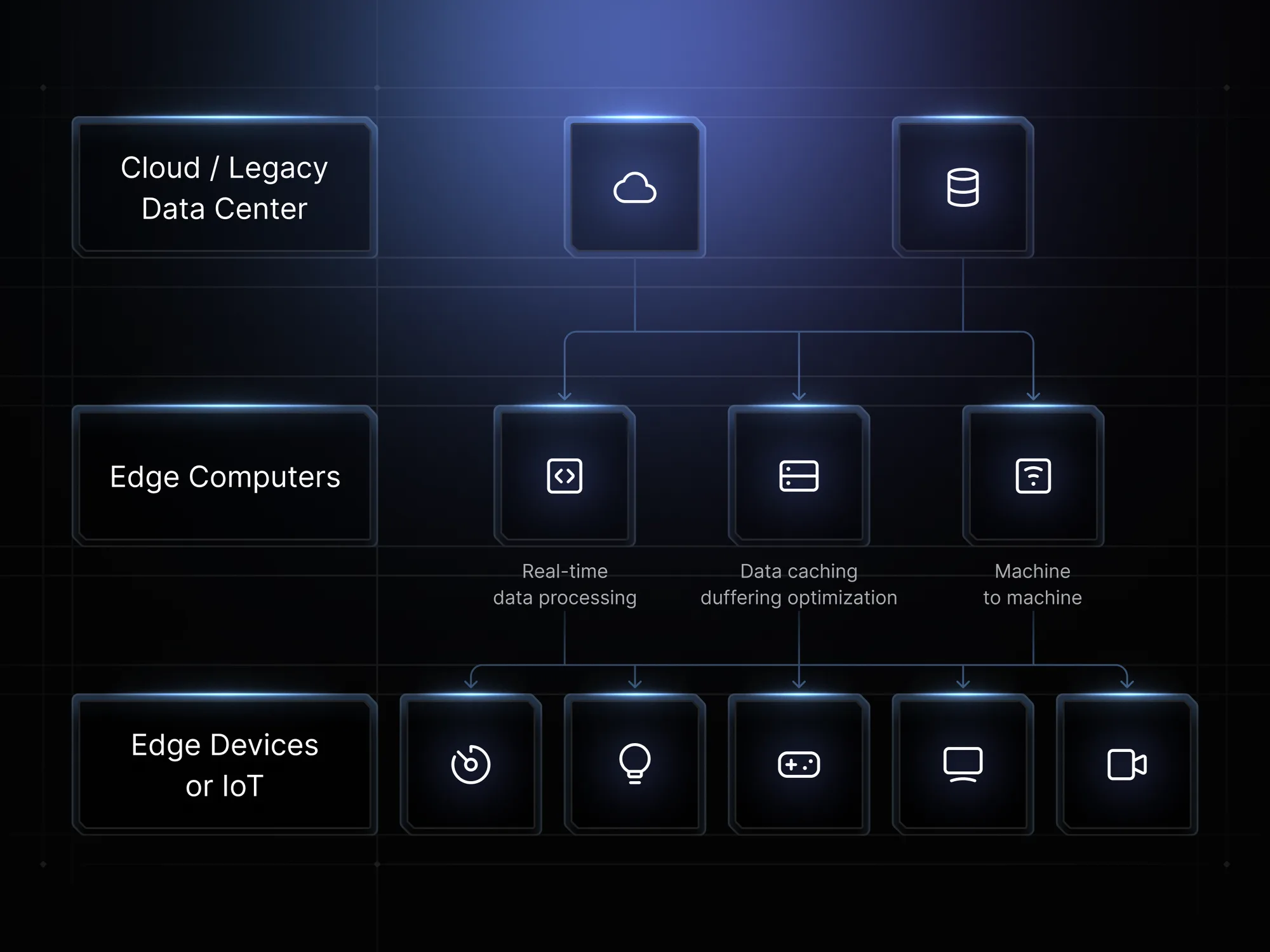
By reducing the distance that data must travel to be processed, mobile edge computing creates several distinct advantages over its cloud competitors that are essential for AI/ML mobile applications. MEC shifts workloads from the core network to the network edge, reducing reliance on the core network and enabling telcos to modernize services and enhance flexibility. The radio access network (RAN) plays a critical role in integrating MEC, enabling operators to deploy cloud services closer to users and improve network efficiency.
- Reduced Latency: MEC processes data within 10-50 kilometers compared to hundreds of miles away in cloud providers.
- Bandwidth Optimization: Most processing occurs locally, and only essential data is sent to centralized clouds, reducing network congestion
- Improved Security / Privacy: Users’ most sensitive data can be processed locally without leaving the edge.
- Increased Reliability: Applications continue to function as usual without requiring continuous cloud connectivity.
- Edge Servers: Provide essential computing resources and storage capacity to support real-time analytics, machine learning, and low-latency query processing.
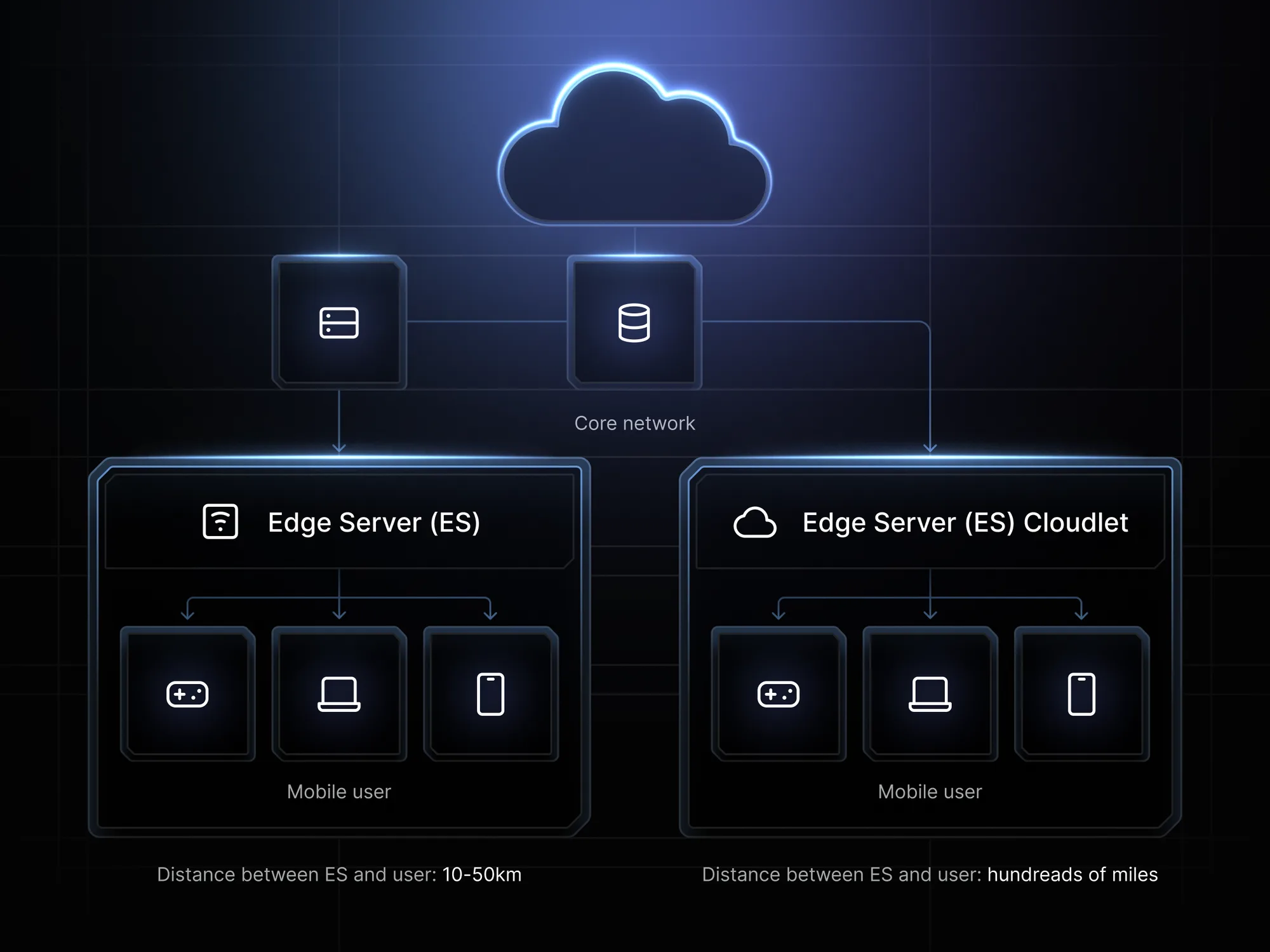
MEC architecture includes components such as edge servers, network architecture, and integration with software-defined networking (SDN) and network functions virtualization (NFV).
Benefits of Mobile Edge Computing
Mobile edge computing brings a host of benefits to both mobile users and network operators by processing data closer to where it is generated. For mobile users, MEC delivers a smoother, more responsive experience by reducing latency and enabling real-time applications. By handling data at the mobile edge, network congestion is significantly reduced, as less information needs to traverse the entire network to reach a central cloud. This not only improves network efficiency but also allows mobile operators to introduce new services and applications that were previously impossible due to latency or bandwidth constraints. As a result, MEC empowers mobile operators to enhance the quality of experience for their subscribers, optimize network resources, and unlock new revenue streams through innovative edge computing solutions.
Mobile Edge Computing and the Industry Specification Group
The evolution of edge computing has been guided by the European Telecommunications Standards Institute (ETSI), which established the Industry Specification Group (ISG) for Multi-Access Edge Computing (MEC). This group has developed a comprehensive framework and set of standards for deploying access edge computing MEC solutions, ensuring interoperability and scalability across the telecommunications industry. MEC extends traditional cloud computing by bringing processing power and storage to the network edge, closer to mobile devices and data sources. The ETSI ISG MEC standards define the architecture, functional components, and APIs necessary for seamless integration of edge computing into existing network infrastructure. By standardizing MEC architecture, ETSI enables service providers and application developers to build and deploy edge computing applications that deliver low latency, high performance, and enhanced user experiences across diverse network environments.
Accelerating Mobile Edge Computing with 5G and Mobile Networks
Running parallel to the advancement of MEC is the continued expansion of 5G networks. Together, MEC and 5G enable advanced network services, supporting real-time applications and improved scalability. 5G networks can deliver network speeds more than 20x faster than LTE. At the same time, MEC brings the compute execution closer to the end user, reducing the overall latency of the network. Wireless networks, including cellular networks, provide the essential infrastructure for integrating MEC and 5G, enabling reliable connectivity and high-speed data transmission for IoT and other applications. The convergence of the two technologies addresses four pain points that dynamic mobile AI/ML applications have been encountering:
- High Latency: Significantly faster network speeds and lower latency allow for 1ms responses for critical applications, as MEC optimizes data transmission to achieve low latency network performance.
- Device Connectivity: Connects thousands of IoT devices per square kilometer for increased local data flow, leveraging wireless networks and cellular network infrastructure.
- Network Slicing: Creates dedicated virtual networks that are resilient to cloud outages and other disruptions, allowing for uninterrupted service.
- Edge Orchestration: Enables dynamic workloads based on real-time demand.
Additionally, MEC enables faster, real-time applications for gaming, autonomous cars, and video analytics on 5G networks.
Mobile Edge Computing AI/ML Applications
It is important to recognize that the advancement of MEC does not necessarily entail the complete elimination of cloud processing. For most projects and applications, a hybrid model that leverages edge processing for real-time decisions, while utilizing cloud connectivity for model updates and complex analytics, will likely be the best approach. MEC processes the data produced by edge devices close to its data source, supporting real-time analytics and business intelligence for faster and more informed decision-making. The integration of cloud services with MEC supports scalable and secure application deployment, bridging the gap between edge and cloud environments. Additionally, microservices provide an application service environment at the edge, enabling improved performance and responsiveness for mobile users.
MEC enables real-time insights for applications like AI analyzing video feeds or cars sharing traffic information instantly.
Understanding this dynamic for AI/ML applications is key. Edge computing for AI/ML applications on mobile thrives in environments like:
Real-Time Inference Applications
Edge AI hardware, such as the NVIDIA Jetson AGX Orin, provides the compute infrastructure necessary for computationally demanding applications, including autonomous robots, drones, and self-driving vehicles, to succeed. MEC enables real-time video analytics by processing video streams locally, supporting applications such as security cameras that can identify potential threats via facial recognition before they cause harm. Mobile applications enhanced by MEC can perform object detection, facial recognition, and natural language processing with minimal latency while preserving user privacy through local processing.
MEC also supports augmented reality (AR) applications by allowing remote workers to perform maintenance and repair tasks with real-time data overlays, enabling collaborative tasks in the field. When it comes to autonomous robots, self-driving vehicles, and industrial machines, MEC supports instant processing of sensor data for rapid collision avoidance and enhanced operational efficiency.
Mobile AI Agents
Localized mobile AI agents that require dynamic response times, particularly benefit from the advancement of mobile edge computing, which supports smart devices and connected devices by enabling real-time data processing. Lightweight models, such as Yi, Phi, and Llama3, can achieve generation throughput of 5 to 12 tokens per second with less than 50% CPU and RAM usage on edge devices. MEC also minimizes lag in AR/VR headsets to provide smooth, high-resolution graphics, and reduces latency for cloud gaming, allowing gamers to access high-quality games from thinner clients.
Implementation Strategies for Edge AI Deployment
Successfully deploying AI workloads through MEC requires careful consideration of model optimization, hardware constraints, and network orchestration. Telcos also need to streamline network operations to support MEC and effectively handle a growing number of edge devices and applications.
When orchestrating the network, it is important to note that MEC relies on network functions virtualization (NFV) to run applications as virtual machines or containers on standard hardware. NFV enables flexible deployment of network services, such as routers and firewalls, on standard servers within telco clouds.
For hardware and software selection, evaluating MEC capabilities and cloud computing capabilities is essential to ensure optimal performance and seamless integration with existing network environments.
Additionally, local processing in MEC extends the battery life of IoT and mobile devices by reducing the need for long-distance communication.
Model optimization techniques:
Frameworks like Google's LiteRT (formerly TensorFlow Lite) offer lightweight alternatives specifically designed for mobile and edge devices, emphasizing memory efficiency and fast execution times.
Hardware Selection
When choosing between specialized AI accelerators, such as Google's Edge TPU, and general-purpose processors, the decision depends on specific application requirements and power constraints. Developers should clearly understand their applications' demands before hardware selection takes place.
Network Orchestration
Kubernetes-based solutions, such as K3s, offer lightweight container orchestration specifically designed for edge deployments, enabling automatic scaling and seamless integration with existing cloud infrastructure.
Digital Service Provider Benefits
For digital service providers, mobile edge computing (MEC) opens up new opportunities to deliver cutting-edge services and applications that set them apart in a competitive market. By leveraging edge computing, providers can offer immersive experiences such as augmented reality and virtual reality, as well as support for autonomous vehicles and other innovative applications that require real-time data processing. MEC helps digital service providers reduce network congestion and improve the quality of experience for their customers by processing data at the mobile edge, closer to end users. This not only enhances service reliability and responsiveness but also enables the rapid deployment of new services tailored to the evolving needs of enterprise and consumer markets. By embracing MEC, digital service providers can drive digital transformation, unlock new revenue streams, and position themselves as leaders in delivering next-generation connectivity and applications.
Emerging Edge Computing Narratives
As the pace of innovation accelerates and more AI/ML mobile applications come online, mobile edge computing will play an increasingly leading role in local data processing. The MEC market is still in its early stages, but analysts forecast high growth potential, with estimates ranging from USD 0.6 billion in 2024 to USD 16,090 million by 2030. This rapid expansion highlights the significance of MEC as a medium to long-term opportunity for telcos and industry stakeholders. As traditional voice and data services become commoditized, MEC offers telcos new opportunities to build revenue streams by enabling advanced applications and services.
Mobile edge clouds and edge cloud infrastructure are essential for supporting new low-latency applications, facilitating data processing closer to end-users, and enhancing operational efficiency across sectors like IoT, automotive, security, and enterprise. The evolution of edge computing is driven by the need to process and manage data from wireless devices at the network edge, reducing reliance on remote servers and minimizing latency compared to traditional cloud computing models.
Edge infrastructure is underpinned by data centers that host MEC hardware, enabling scalable and secure connectivity. These data centers are purposefully located to support distributed edge environments, reduce latency, increase bandwidth, and enhance overall system performance.
Several companies are shaping the MEC landscape: FogHorn Systems provides edge intelligence software for Industrial IoT (IIoT), significantly reducing processing and storage costs. ADVA delivers network equipment for MEC, including the FSP 150 hardware series and Ensemble software suite. Equinix's Network Edge is a virtual network that enhances MEC and reduces hardware requirements for communication service providers. Akamai's Intelligent Edge Platform uses advanced cybersecurity protocols to protect edge computing infrastructure and is trusted by major global brands. ClearBlade offers edge computing software that allows businesses to securely run and scale IoT devices in real-time. Saguna enables MEC for mobile operators and enterprises, supporting 5G features over existing 4G networks. Azion helps businesses build scalable, secure server-less applications at the edge, connecting to any cloud services. Vapor IO uses colocation facilities to bring cloud-like services to the edge of wireless networks, placing IT equipment close to users. EdgeConneX delivers edge infrastructure solutions via purposefully located data centers to improve streaming and speed for mobile networks. Section provides cloud-native hosting solutions for development and operations engineers, allowing users to deploy applications across multiple edge clusters. Schneider Electric offers hardware and architectures for facilitating MEC capabilities, including preconfigured micro data centers.
Some narratives to pay close attention to are:
- Neuromorphic Computing: Designing hardware and software that simulate the neural and synaptic structures and functions of the brain to process information. This market is set to grow from $1.44 billion in 2024 to an expected $4.12 billion by 2029.
- Decentralized GPU Networks: DePIN platforms, such as VOLT, can provide a full suite of decentralized edge processing applications that developers can tap into. They can enable dynamic resource allocation, open GPU marketplaces, and cost-effective scaling for AI/ML workloads. For example, VOLT Cloud is the programmable infrastructure layer of VOLT, providing developers and enterprises with access to decentralized GPU clusters that offer the scale, speed, and control necessary to train, deploy, and run real AI workloads.
The Future of Distributed Mobile Edge Computing
Mobile edge computing represents more than a simple network upgrade for an existing centralized system. It is helping lay the infrastructure foundation for the future of mobile-based data processing. MEC processes the vast amounts of data produced by smart devices and connected devices in smart cities, supporting efficient data transmission and real-time urban management. By processing data close to its data source, MEC also facilitates compliance with data sovereignty laws like GDPR and HIPAA by keeping sensitive data within local networks. Its ultimate success will not be determined by replacing cloud-based processing but by acting harmoniously alongside it in hybrid models. Cloud will still have its place in larger AI/ML processing functions, but for the immediate dynamic intake and processing of real-time data, MEC opens new opportunities for teams building in the space. MEC maintains operational resilience by allowing edge nodes to function independently during network disruptions.
Its convergence with the advancement of 5G networks is helping establish the next generation of AI applications where sophisticated machine learning capabilities can operate seamlessly across millions of edge devices.