Try VOLT Intelligence
Get StartedTry VOLT Cloud
Deploy GPUTable of Contents
- What happens with the AWS-Nvidia announcement
- The vendor lock-in layer cake: where it hides
- Proprietary inference engines
- Fine-tuning adapter formats
- Egress fees
- Support tier dependencies
- Visualizing the true costs of switching AI infra
- The migration tax on a mid-scale AI team
- GPU vendor lock-in is an AI infrastructure risk for your team
- Capacity risk
- Compliance risk
- Cost volatility risk
- How VOLT redefines AI infra to avoid vendor lock-in
- What is vendor lock-in in cloud GPU infrastructure, and why does it matter for AI teams?
- How do AWS egress fees contribute to GPU vendor lock-in?
- What does a multi-cloud GPU strategy look like in practice for AI infrastructure?
- How does the AWS-Nvidia GPU capacity expansion affect AI infrastructure risk for independent teams?
- What specific costs make up the vendor lock-in tax in AI infrastructure?
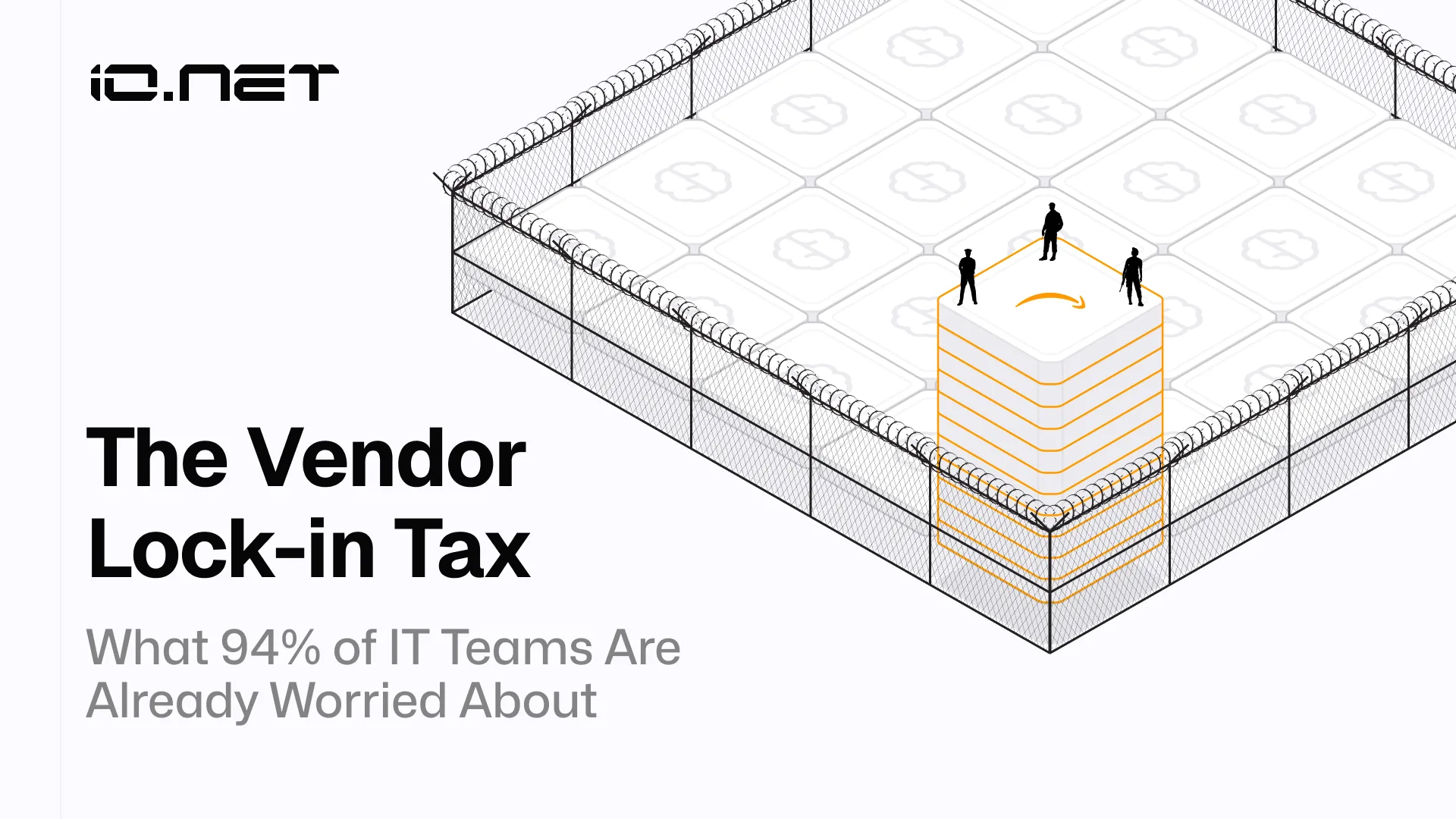
Vendor lock-in used to be the province of IT departments. Now it’s a real budget risk. According to widely-cited survey data, 94% of IT professionals report concern about vendor lock-in. For anyone dealing with AI infrastructure, that worry is about to get more expensive.
On August 26, 2026, AWS announced an expanded multi-billion-dollar commitment to Nvidia GPU capacity that cemented the hyperscaler-as-gatekeeper model. It did so at precisely the moment AI workloads are scaling the fastest. When you run on one cloud's proprietary stack, you are not only renting compute but also dependency.
This post lays out what vendor lock-in actually costs in AI infrastructure, where the hidden taxes accumulate beyond raw GPU hours, and why decentralized compute architectures are a true solution instead of just quick and helpful workaround.
What happens with the AWS-Nvidia announcement
AWS's August 26, 2026 GPU capacity expansion is the kind of announcement that generates positive press coverage. However, it deserves some real scrutiny from anyone building AI infrastructure. More Nvidia GPUs powering AWS sounds like more supply. At first glance, great! That should mean lower prices and more availability. Well, the actual effect is more complicated. When a single cloud provider commands a dominant share of a specific GPU model's available capacity, they set the effective floor for that hardware's market price. Now, they’re not doing it through malicious price-fixing, but instead through the reality that buyers with no alternatives have no negotiating leverage.
AWS has consistently priced H100 instances at a significant premium to spot market rates. Nvidia capacity concentrated in AWS's data centers is capacity that independent GPU providers, research institutions, and decentralized networks cannot access at the hardware level.
This impacts vendor lock-in in a specific way: capacity concentration and proprietary stack lock-in compound. If you build your inference pipeline on AWS SageMaker using AWS's managed Inferentia or Trainium chips, you face lock-in in four different ways: 1) at the hardware level (chip architecture), 2) the software level (SageMaker SDK), 3) the networking level (VPC egress), and 4) the commercial level (reserved instance commitments).
What does this mean? It’s good evidence that hyperscaler dependency in AI infrastructure is intensifying instead of normalizing, and that isn’t good for lean AI startups and research teams who need GPUs but don’t have the kind of budgets that can sustain vendor lock-in.
The vendor lock-in layer cake: where it hides
Hardware pricing is visible. The real vendor lock-in tax accumulates in places that don't show up cleanly on a monthly GPU bill. Think of it like a layer cake. Let’s cut that cake open.
Proprietary inference engines
AWS Inferentia and Google TPUs deliver cost efficiency, but efficiency that is only accessible through vendor-specific compilation toolchains. Compiling a model for Inferentia requires AWS Neuron SDK. A model optimized for Neuron does not run on A100s, H100s, or anything else without recompilation. In practice, this means re-testing, re-benchmarking, and re-validating latency profiles from scratch. That is engineering time, and it is a tax paid every time you consider leaving.
Fine-tuning adapter formats
Managed fine-tuning services can introduce portability friction depending on whether the provider exposes model weights or adapters, which model versions are available elsewhere, and whether the serving configuration can be reproduced outside the platform. Moving a fine-tuned adapter from AWS Bedrock's fine-tuning service to a self-managed vLLM endpoint is not trivial. The adapter may need conversion, the base model version must match exactly, and the serving configuration has to be rebuilt. Teams that fine-tune on a managed service and then discover they want to move have usually already paid the lock-in tax without knowing it.
Egress fees
This is the oldest trick in the cloud pricing playbook and, no surprise, it’s still the most effective one.
AWS charges $0.09/GB for data transferred out of its network (as of mid-2026, standard tiered pricing). A training dataset at 500 GB costs $45 to egress once. Move it twice and you've spent $90. A mature ML pipeline with regular data movement can generate egress bills that dwarf compute costs. Google Cloud's egress pricing structure is similar. Neither company advertises this prominently when quoting GPU instance pricing.
Support tier dependencies
Enterprise SLAs on AWS and GCP are priced as a percentage of total spend. At $100,000/month in GPU spend, AWS Enterprise Support is $10,000/month before you've even filed a single ticket. That support contract becomes a recurring cost that scales with usage and resets to zero if you migrate. You can’t migrate it.
Visualizing the true costs of switching AI infra
Hyperscalers won’t make known the true costs of migrating your models from one AI infrastructure ecosystem to another. But we will.
The migration tax on a mid-scale AI team
To get an idea of what the vendor lock-in tax looks like, imagine a mid-scale AI team running an AWS p5.48xlarge instance, equipped with 8x H100 SXM5 GPUs, at an on-demand rate of $55.04/hr (that’s roughly $6.88/hr per GPU in US East), at 730 hours of continuous uptime. The numbers below factor in feeds for storage, data egress, and support.
- 1x p5.48xlarge node (8x H100s) × $55.04/hr × 730 hours = $40,179/month in compute
- AWS Enterprise Support (estimated 10% tier) – $5,000/month
- Estimated egress (1 TB/month training data movement) – $92/month
- Reserved instance discount – Team remains on on-demand to retain flexibility, forfeiting term discounts
- Total monthly all-in – Approximately $45,271/month
Now, let’s say that this team decides to evaluate alternatives. Here are the migration costs to price in:
- Engineering overhead – Time to recompile and re-validate models off the vendor-specific SDK: [Sherman flag: supply a realistic engineering-hours number here if you have one from customer data; I'm not inventing a figure]
- Data egress – Transferring existing training datasets and model weights to a new provider: 2 TB × $0.09/GB = $184 one-time
- Parallel running period – Running both environments for 30 days to benchmark and validate the cutover doubles compute spend for one month = $40,179 additional
- Stranded financial commitments – Unused term discounts or remaining reserved commitments if tied to a longer contract: variable.
The parallel running period alone is the dominant migration cost: an entire month of double-paying just to de-risk the transition. Teams that have never migrated off a hyperscaler often underestimate this upfront friction. The result is a rational decision to stay, not because the incumbent offers a superior stack, but because leaving is expensive enough that the status quo wins by default.
That’s the vendor lock-in tax working as designed.
GPU vendor lock-in is an AI infrastructure risk for your team
IT teams framing lock-in as a preference question are underestimating the risk category. Vendor lock-in in AI infrastructure generates several other risks, including ones for capacity, compliance, and cost volatility.
Capacity risk
It’s well known at this point that AWS allocates its H100 fleet, it prioritizes its largest enterprise customers and its own internal workloads (Amazon Alexa, Amazon Advertising, AWS internal ML). A startup or mid-market company on on-demand pricing is at the back of the allocation queue during demand spikes. The August 2026 capacity expansion doesn't change AWS’s queue ordering, it simply adds more GPUs to a system where priority access still correlates with spend tier.
In other words, your team still isn’t benefitting from that capacity expansion.
Compliance risk
Data residency requirements are tightening globally. GDPR enforcement in the EU, DPDP in India, and emerging state-level regulations in the US create obligations about where training data and model weights can reside. If your AI infrastructure runs entirely in one cloud's regions, your compliance posture depends entirely on that cloud's data center footprint. Adding a compliant region means re-architecting within the same proprietary environment, or leaving.
Cost volatility risk
Reserved instances and committed use discounts are priced at signing. A team that committed to 3-year H100 reservations at 2024 pricing when H200s and B200s became available in 2025–2026 found themselves paying above-market rates for older hardware they couldn't easily swap. Lock-in and hardware generation cycles interact badly.
How VOLT redefines AI infra to avoid vendor lock-in
VOLT's architecture is multi-provider by design, not as a feature bolted on after the fact. The distributed GPU network aggregates supply from independent data centers, enterprise GPU owners, and consumer hardware contributors across geographies. That very supply diversity is what makes vendor lock-in structurally difficult.
When no single provider controls GPU capacity allocation for your workload, your AI team enjoys the leverage. If one node cluster becomes unavailable or prices up, the scheduler routes to alternatives. VOLT’s compute network does this not because there's a migration team standing by, but because the architecture expects provider diversity as a baseline condition. Diversity is VOLT’s default state, and it benefits providers and users alike.
Pricing on VOLT is transparent and on-demand. An H100 PCIe runs at $1.49/hr as of mid-2026. There is no support tier percentage on top, nor are there reserved instance commitments required to access a reasonable rate or egress fee structure designed to make leaving expensive.
The comparison table below shows where the all-in cost difference lands for a team running 8 GPUs continuously:
On proprietary inference formats, VOLT workloads run standard CUDA, vLLM, and HuggingFace inference stacks. There are no custom SDKs or vendor-specific compilation. Thanks to VOLT’s commitment to open tooling, a model that runs on VOLT today can run on any CUDA-capable hardware tomorrow.
Fine-tuning adapters trained through VOLT's managed environment serialize to standard LoRA checkpoint formats compatible with the broader HuggingFace ecosystem. As far as egress fees go, VOLT does not charge for outbound data transfer the way hyperscalers do. Quite simply, leaving is not built into the pricing model as a cost.
In the interest of transparency, VOLT does eliminate all migration considerations— adapting to distributed cluster topologies and distributed validation, amongst a few others. Indeed, no platform can full eliminate migration friction. But the lock-in tax that accumulates on hyperscaler platforms (proprietary tooling, egress fees, support tier percentage, reserved commit break fees) simply doesn't exist in the same structure on VOLT's distributed network. The architecture makes it structurally difficult to replicate those lock-in mechanisms, because no single entity controls the full stack.
Provision your GPUs today on VOLT, and skip that vendor lock-in tax.
Save up to 70% on GPUs, wihtout the lock-in.
Related Questions
What is vendor lock-in in cloud GPU infrastructure, and why does it matter for AI teams?
Vendor lock-in in cloud GPU infrastructure occurs when your AI workloads become technically or commercially dependent on a specific provider's stack — proprietary chips, managed inference services, reserved instance pricing, or egress fee structures that make migration expensive. For AI teams, lock-in matters because it limits your ability to respond to hardware generation changes, price increases, capacity constraints, and compliance requirements. A team locked into AWS's Inferentia chips cannot easily move to H200s offered by another provider without recompiling and re-validating their models. At scale, that re-validation cost (as engineering hours and parallel running periods) can exceed the cost differential that motivated the evaluation in the first place.
How do AWS egress fees contribute to GPU vendor lock-in?
AWS charges $0.09/GB for data transferred out of its network at standard rates. For AI teams with large training datasets, this creates a recurring cost that scales with data volume and penalizes multi-cloud strategies. Moving a 1 TB dataset out of AWS for evaluation on another GPU provider costs $92. Running regular evaluations across providers, or migrating an active training pipeline, multiplies that cost. Because egress fees apply on exit but not on ingress, the pricing structure is asymmetric in a way that systematically favors keeping data within AWS. This is a measurable component of the lock-in tax.
What does a multi-cloud GPU strategy look like in practice for AI infrastructure?
A genuine multi-cloud GPU strategy routes workloads across providers based on availability, pricing, and latency requirements as a normal operational mode. In practice this requires a workload orchestration layer that is provider-agnostic, model serialization in open formats (standard PyTorch checkpoints, HuggingFace-compatible LoRA adapters), and inference serving via open-source stacks (vLLM, TGI) rather than managed services tied to a specific cloud. Decentralized GPU networks like VOLT implement this natively: the scheduler treats provider diversity as a baseline constraint, not a special mode. For teams starting from a single-cloud position, the migration path is incremental: route new workloads to the multi-provider network while existing pipelines complete their reserved instance cycles.
How does the AWS-Nvidia GPU capacity expansion affect AI infrastructure risk for independent teams?
The August 2026 AWS-Nvidia commitment concentrates more high-end GPU capacity inside a single cloud provider's allocation system. For enterprise AWS customers, this looks like good news: more supply available through a trusted procurement channel. For independent teams, the effect is more nuanced. Capacity concentrated in one provider's network is capacity that spot markets, independent data centers, and decentralized networks cannot access at the hardware level. If Nvidia's H100 and B200 production capacity is substantially allocated to hyperscaler commitments, the spot market supply available to alternatives narrows. Independent teams that rely on hyperscaler spot instances also face the allocation queue dynamic — during demand spikes, enterprise customers with long-term commitments get priority.
What specific costs make up the vendor lock-in tax in AI infrastructure?
The vendor lock-in tax in AI infrastructure compounds across several layers: reserved instance break fees or stranded spend if you exit early; egress fees on training data and model weights; engineering time to recompile models off proprietary inference toolchains; parallel running costs during migration validation (typically one full month of double-paying); and support tier fees that scale as a percentage of total spend. For a team at $200,000/month in AWS all-in spend, a conservative lock-in tax calculation — one month parallel running ($182,344) plus support tier loss ($18,234/month foregone discount) plus egress ($184 for 2 TB) — lands near $200,000 before counting any engineering time. That figure explains why most lock-in evaluations conclude with a decision to stay.